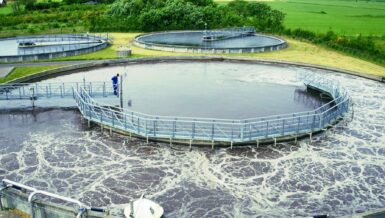




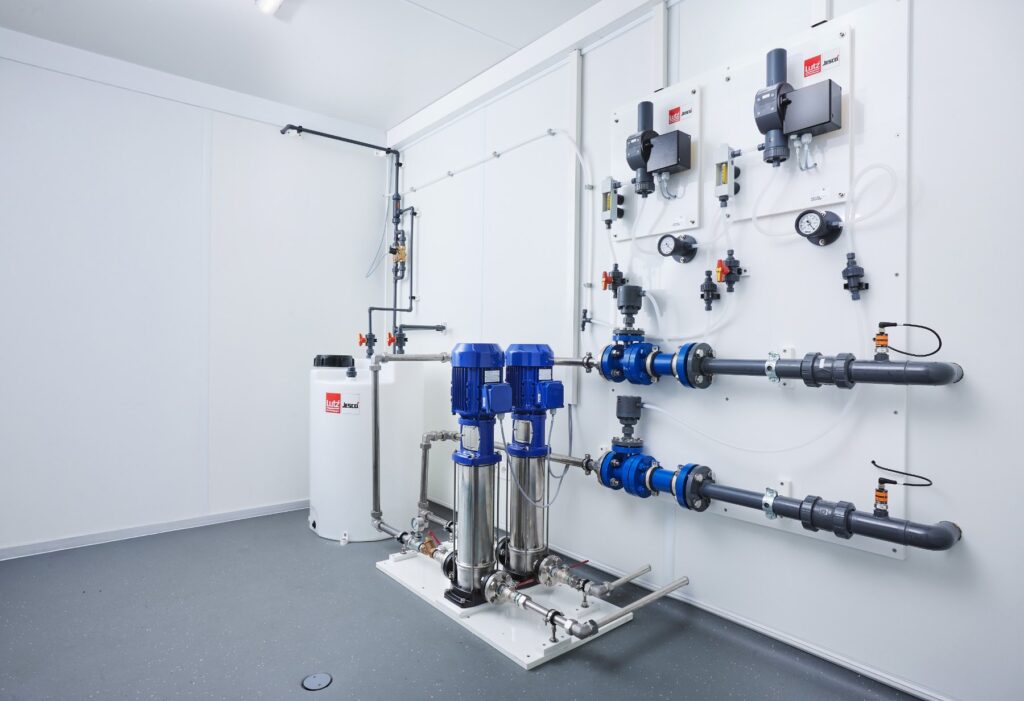
- Decentralized Water Supplyseveral smaller, distributed supply units
- Mobile Waterworksaround 300 cubic meters of water per hour
- On-Site Chlorine Productionfrom standard table salt
A Concept for Decentralized Water Supply
This approach makes it possible to create additional local supply capacities without having to build a complete conventional waterworks at every site.
Michael RaabeHead of Sales at Lutz-Jesco
At the heart of this approach is a concept for decentralized water supply. In this model, a central waterworks no longer provides drinking water alone; several smaller, distributed supply units supplement it. This ensures that the supply can still be maintained in areas, even if individual sites fail. “The necessary treatment and disinfection technology can be largely preassembled and tested in containers,” explains Michael Raabe, Head of Sales at Lutz-Jesco. At the deployment site, the units are connected to a suitable water source and the required infrastructure.
Mobile Waterworks for Flexible Deployment
Lutz-Jesco already demonstrated back in 2025, in an international project, that mobile treatment technology is ideally suited for rapidly establishing decentralized supply structures. The company equipped three mobile waterworks for Ukraine with treatment technology – with support from the Deutsche Gesellschaft für Internationale Zusammenarbeit (GIZ). “Together, the mobile systems achieve a treatment capacity of around 300 cubic meters of water per hour,” explains Michael Raabe. “This enables the supply of clean, safe drinking water to around 300,000 people.”
On-Site Chlorine Production

Another advantage of mobile water treatment is Lutz-Jesco’s integrated electrolysis technology. It generates the chlorine required for disinfection directly on site from standard table salt. This makes operation at spatially distributed sites easier and reduces dependence on the continuous supply of disinfection chemicals.
For smaller or short-term supply points, Lutz-Jesco also offers SAFETYCHLORMIX, a plug-and-play chlorination plant mounted on a handcart. This lets a single person move the ready-to-operate system to the deployment site and start it immediately. “This means the disinfection technology can be brought precisely to where it is needed at short notice,” explains Michael Raabe. “That also makes this solution attractive for decentralized supply concepts.”
Talks with Ukrainian Cities, Municipalities and Utilities
At ReBuild Ukraine 2026, Lutz-Jesco plans to speak with representatives of Ukrainian cities, municipalities, and utilities about how decentralized solutions can support rebuilding and further advancing the country’s water infrastructure.