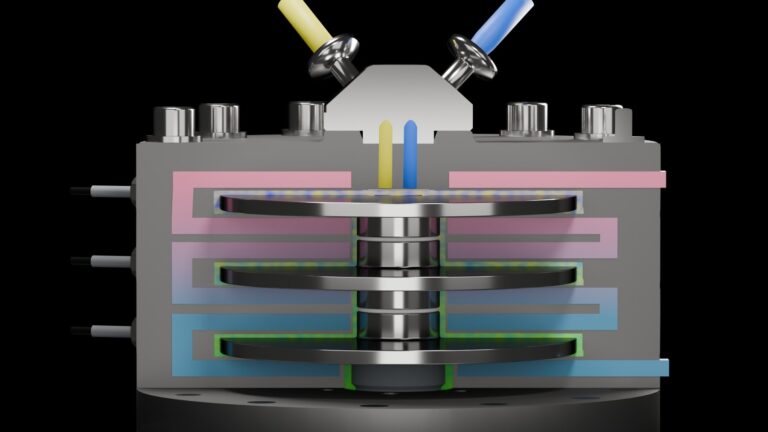
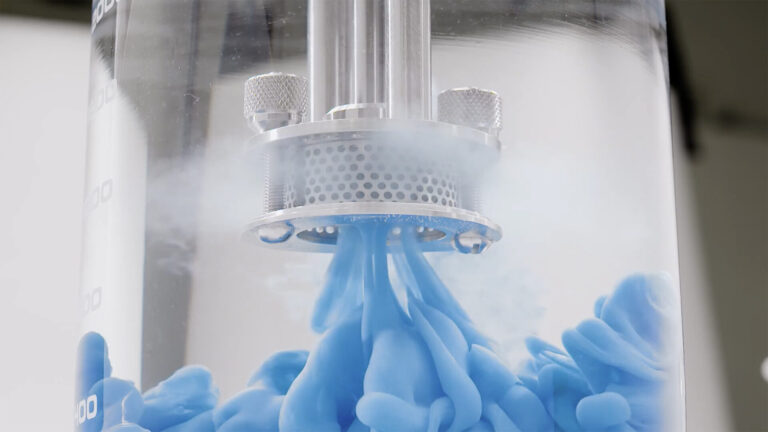
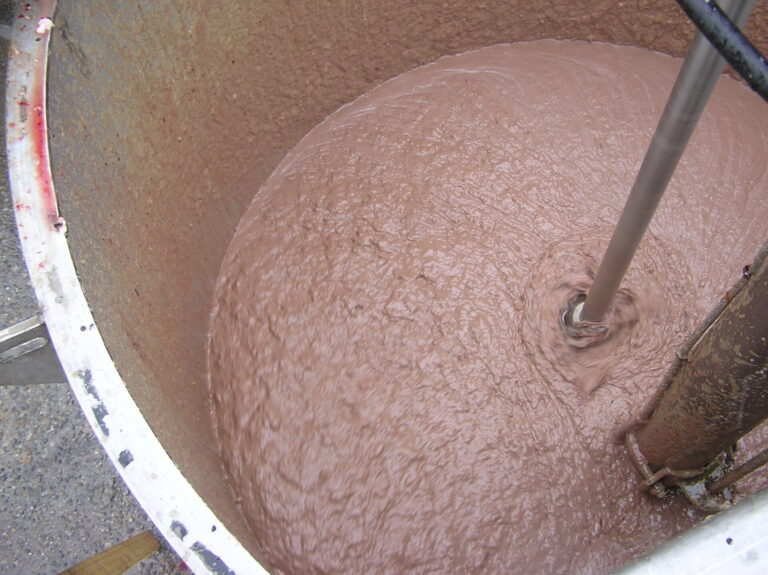
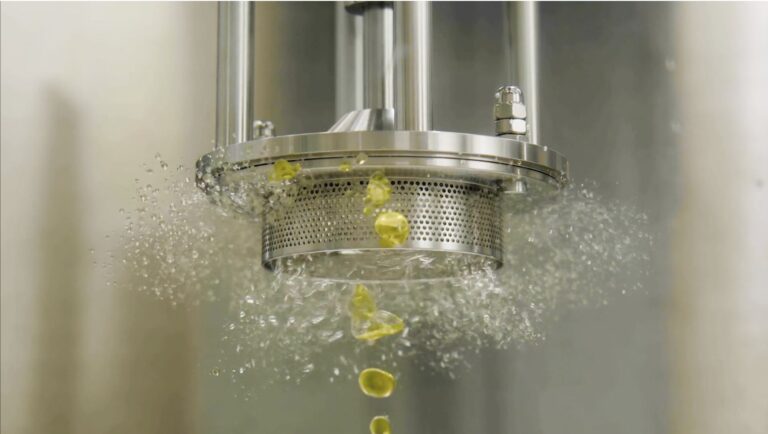
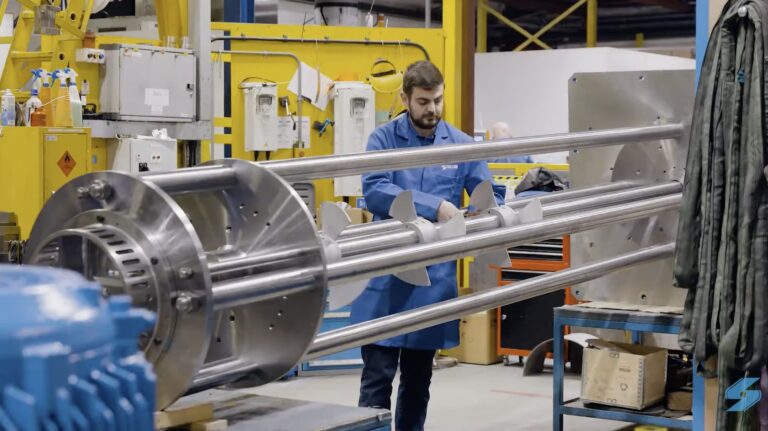
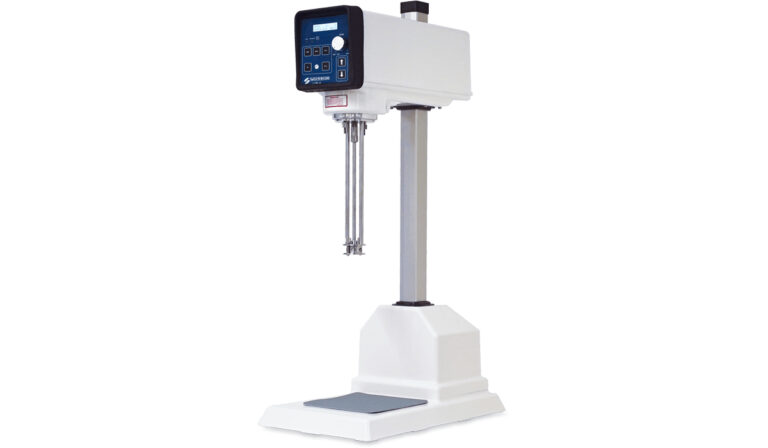
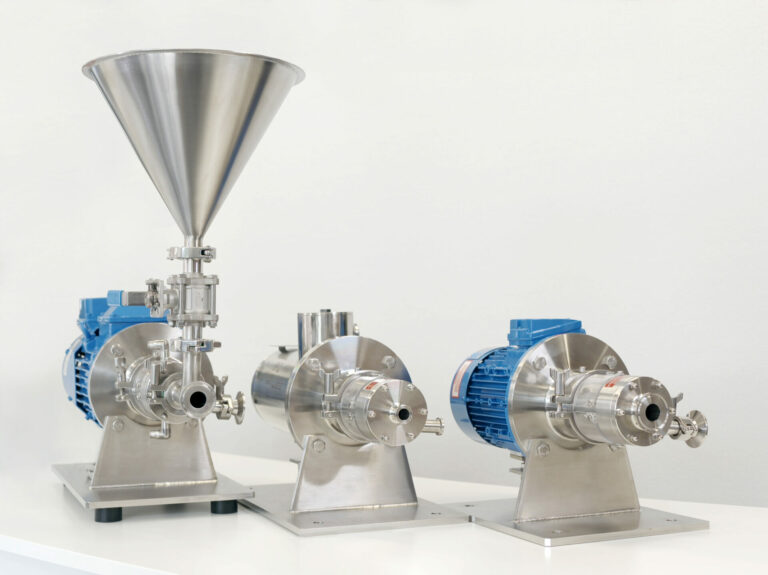
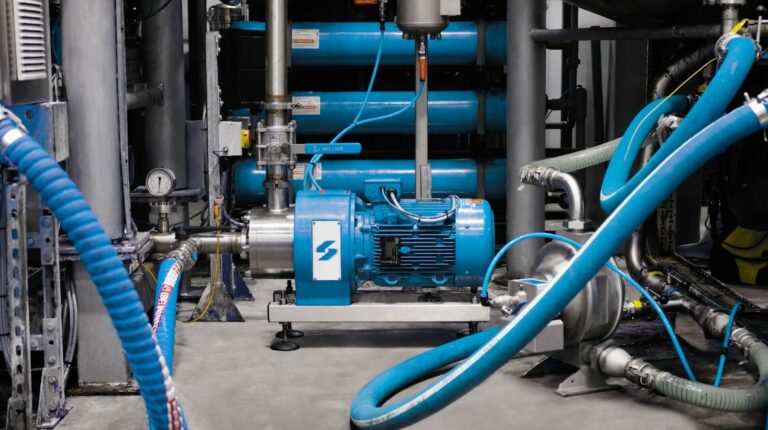
Fluid mixing technology brings liquids, gases and solids to a homogeneous product. This zone covers agitators, static and inline mixers, high-shear and vacuum mixers and the tanks they work in.
Why Grignard chemistry should be done in flow: An overview of industrial challenges associated with Grignard reagents and the benefits of continuous processing and manufacturing for this chemistry.…
Fluid Mixing: how it works, key numbers and troubleshooting
Fundamentals
What mixing is actually for
Four jobs hide behind the same word. Blending brings two miscible liquids to one composition; suspension keeps solids off the bottom; dispersion breaks a gas or a second liquid into droplets; and heat transfer moves the product past a jacket fast enough to keep it uniform. Each one has its own impeller, its own speed and its own definition of finished, and a vessel designed for one of them rarely does another well.
Impellers and what they move
Axial impellers, the pitched blade and the hydrofoil, push flow up or down the vessel and are what suspension and blending want. Radial impellers, the Rushton turbine above all, throw flow outward into the baffles and generate the shear that gas dispersion needs. High shear rotor stator heads work on a small volume at very high shear for emulsions. Flow and shear trade against each other, and the choice is which of the two the product needs.
Baffles, geometry and the vortex
An unbaffled vessel spins the whole contents as a body and mixes almost nothing while looking busy. Four baffles at a tenth of the diameter break that rotation and turn rotation into flow. The rest of the geometry follows the same logic: impeller diameter roughly a third of the tank, clearance about one impeller diameter from the floor, and a second impeller once the liquid height passes about 1.2 times the diameter.
Inline and static mixing
Not everything needs a vessel. A static mixer divides and recombines the stream in a fixed set of elements and blends two liquids in a few pipe diameters with no moving parts and no power beyond the pressure drop. Inline rotor stator and dynamic mixers put high shear into a continuous stream. Both remove a batch step, and both need the flow rate to stay inside the range they were designed for.
Scale-up and what stays constant
A recipe that works in a 20 litre pilot does not transfer by keeping the speed. Something has to be held constant, and which something depends on the job: power per unit volume for blending and heat transfer, tip speed for shear-sensitive dispersion, or an equal Froude number where the surface behaviour matters. Trying to hold all of them at once is what makes scale-up fail, because they cannot all be kept.
Key parameters
Parameter
Typical range
Rule of thumb
Impeller to tank diameter
0.3 to 0.5
Large and slow for flow, small and fast for shear
Baffles
4 baffles at 1/10 to 1/12 of tank diameter
Without baffles the contents rotate and mixing time goes to nothing useful
Off-bottom clearance
About one impeller diameter
Too low and the impeller starves; too high and solids stay on the floor
Power input, blending
0.1 to 0.5 kW per cubic metre
Scale on power per volume when the job is blending or heat transfer
Power input, suspension
0.5 to 2 kW per cubic metre
Just-suspended speed is the target; more only wastes energy
Tip speed, shear-sensitive
Below 3 to 5 m/s
Scale on tip speed when cells, crystals or emulsions are involved
Rotor stator tip speed
10 to 25 m/s
Droplet size falls with tip speed and with passes, not with time in the vessel
Static mixer length
5 to 10 pipe diameters for miscible liquids
Check the viscosity ratio; a large one needs far more elements
Troubleshooting
Symptom
Likely causes
What to do
Solids settle on the vessel floor
Speed below the just-suspended point, wrong impeller type, or too much clearance from the bottom
Lower the impeller to about one diameter above the floor, switch to an axial type, and raise the speed to the just-suspended point
A deep vortex forms and draws air in
No baffles, or speed too high for an unbaffled vessel
Fit four standard baffles, or mount the agitator off-centre or at an angle if baffles are not possible
Batch takes far longer than the pilot predicted
Scale-up on the wrong constant, usually speed instead of power per volume
Recalculate on power per unit volume, and check the impeller to tank ratio matches the pilot
Product is damaged, cells or crystals broken
Tip speed too high, or a radial turbine where an axial impeller belongs
Move to a large slow hydrofoil, cap the tip speed, and check the pump in the loop is not doing the damage instead
Emulsion separates within hours
Droplets too large, insufficient passes through the high shear head, or an emulsifier added at the wrong point
Increase tip speed or the number of passes, and add the emulsifier where the shear is highest
Mechanical seal on the agitator leaks
Shaft runout, side load from an unbalanced impeller, or the vessel run at a level that lets the impeller break surface
Check runout and balance, keep a minimum level over the top impeller, and confirm the seal support system
Heat transfer to the jacket falls off
Fouling on the wall, or too little flow along the wall from an axial impeller alone
Clean the wall, add an anchor or scraper for viscous product, and check the flow pattern reaches the heat transfer surface
Engineers and product specialists who answer technical questions from readers. The answer comes back to you by e-mail; when we publish it, other readers benefit too.
Martin Hangaard Andersen, Technical Supervisor with Landia a/s has 20 years of experience with mixing technology, pumps and pumping systems. Martin holds…
Axial impellers, pitched blade and hydrofoil, for blending and for keeping solids suspended: they move a lot of liquid for the power. Radial impellers such as the Rushton turbine for gas dispersion, where the shear at the blade tip is the point. Rotor stator heads for emulsions and for breaking agglomerates. If the product is shear-sensitive, choose the largest, slowest impeller that still does the job.
Do I really need baffles?
In a vertical cylindrical vessel with a centre-mounted agitator, yes. Without them the contents rotate as a body, a vortex forms, air is drawn in and very little mixing happens while the motor draws full power. Four baffles at a tenth of the diameter is the standard, and the alternative in a vessel that cannot take them is to mount the agitator off-centre or at an angle.
How do I scale up from the pilot?
Decide first what must stay constant. Power per unit volume for blending, suspension and heat transfer; tip speed where the product is shear-sensitive; an equal Froude number where surface behaviour and vortexing matter. You cannot hold all of them, and scale-up failures are usually the result of holding rotational speed, which is the one thing that means nothing across sizes.
What is just-suspended speed?
The lowest speed at which no particle rests on the bottom for more than a second or two. It is the honest target for a suspension duty, because the power to reach it rises steeply and anything beyond it buys almost no extra uniformity while costing energy and shear. It is measured, not calculated, and correlations only give you the starting point.
Static mixer or a stirred vessel?
A static mixer if the streams are already flowing and the job is blending two miscible liquids, because it works in a few pipe diameters, has no moving parts and costs only the pressure drop. A vessel if the process needs residence time, a reaction, heat transfer or solids kept in suspension. Static mixers are also unforgiving about flow rate: outside the design range they stop mixing.
How do I mix a very viscous product?
Give up on turbulence and design for movement. Anchors, helical ribbons and scrapers move the whole contents and keep the heat transfer surface clean, at low speed and high torque. Standard turbines simply carve a cavern around themselves while the rest of the vessel sits still, which looks like mixing on the ammeter and is not.
Why does the same recipe behave differently in two identical vessels?
Usually because they are not identical where it counts: impeller clearance, baffle condition, fill level, or a replacement impeller of a different type fitted at some point. Check the geometry against the drawing before adjusting the recipe. A missing baffle or an impeller mounted 200 mm higher changes the flow pattern more than any speed adjustment will fix.
What is the difference between this Technology Zone and the Equipment Guide?
The zone is the editorial side: news, case studies, videos, newsletter editions and field experts. The Equipment Guide is the directory side: equipment types and the manufacturers that build them. This page links to its Equipment Guide category and back.
How do I find a manufacturer of fluid mixing equipment?
Open the Equipment Guide category for this zone, pick an equipment type and open a manufacturer profile. Partner profiles carry direct contact details; other listings link to the company website.
Can I ask a technical question before I buy?
Yes. Ask the Expert puts your question to a field expert in this zone. The answer comes back to you by e-mail; when we publish it, other readers benefit too.
Your company in this zone?
Do you manufacture fluid handling equipment and want your company listed under a market? A basic listing is free.
To provide the best experiences, we use technologies like cookies to store and/or access device information. Consenting to these technologies will allow us to process data such as browsing behavior or unique IDs on this site. Not consenting or withdrawing consent, may adversely affect certain features and functions.
Functional
Always active
The technical storage or access is strictly necessary for the legitimate purpose of enabling the use of a specific service explicitly requested by the subscriber or user, or for the sole purpose of carrying out the transmission of a communication over an electronic communications network.
Preferences
The technical storage or access is necessary for the legitimate purpose of storing preferences that are not requested by the subscriber or user.
Statistics
The technical storage or access that is used exclusively for statistical purposes.The technical storage or access that is used exclusively for anonymous statistical purposes. Without a subpoena, voluntary compliance on the part of your Internet Service Provider, or additional records from a third party, information stored or retrieved for this purpose alone cannot usually be used to identify you.
Marketing
The technical storage or access is required to create user profiles to send advertising, or to track the user on a website or across several websites for similar marketing purposes.
Get compact market and technology updates twice a week, with editorial insights and key industry news delivered straight to your inbox. No spam, only practical insights for fluid handling professionals.