Endress+Hauser Inaugurates Its Campus in Cernay
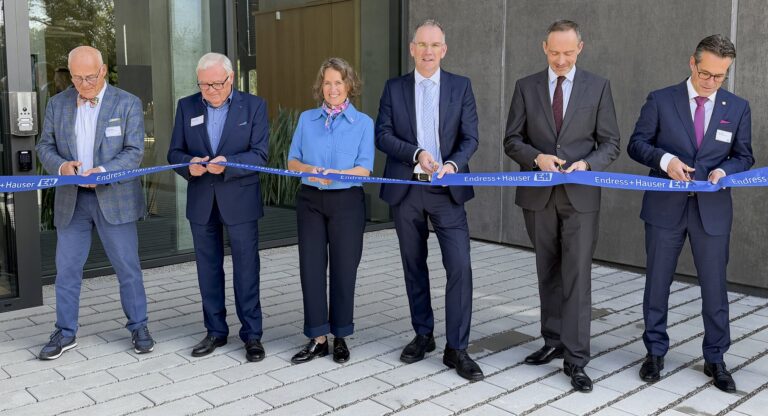
Endress+Hauser inaugurated its new company campus in Cernay, in the Alsace region of France, on 2 October 2026. The event was attended by customers, partners, company employees, and…





Technology Zone
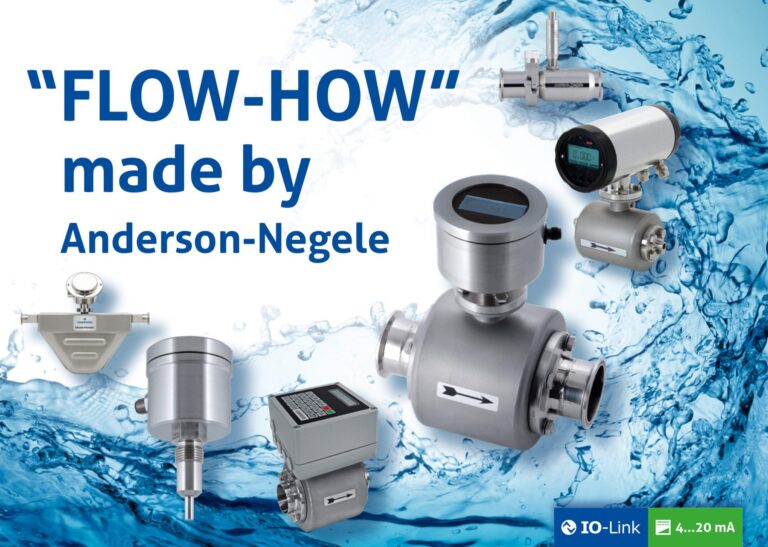
Flow control and measurement keep liquids and gases moving at the right rate. This zone covers flow meters of every principle, electromagnetic, Coriolis, ultrasonic, thermal and vortex, and the controllers that act on them.
Latest in this zone
Endress+Hauser inaugurated its new company campus in Cernay, in the Alsace region of France, on 2 October 2026. The event was attended by customers, partners, company employees, and…

Promoted videos
What this zone covers
Every specification starts with this choice. Volumetric meters report litres or cubic metres per hour at line conditions, so the same reading means a different quantity as soon as pressure or temperature moves. Mass meters report kilograms per hour whatever the conditions. Liquids at stable conditions are usually fine volumetrically; gases, steam, custody transfer and anything batched by weight are safer on mass, either measured directly or corrected with pressure and temperature.
The oldest principles still carry a large share of installed lines. An orifice plate, venturi or nozzle creates a restriction and the pressure drop across it rises with the square of flow, which is why turndown stops at roughly 3:1 without a stacked transmitter. Variable area meters, the glass or metal rotameters, let a float ride in a tapered tube and give a local reading with no power at all. Both are cheap and tolerant of rough service, and both cost permanent pressure drop.
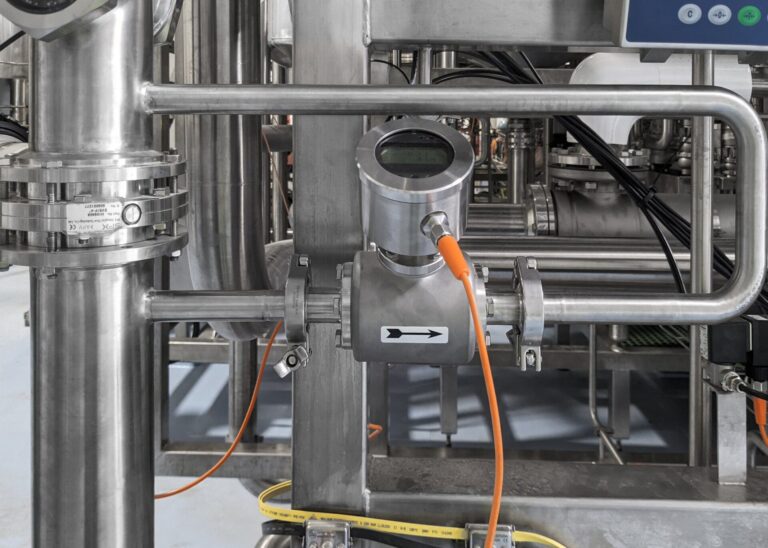
Both leave the bore clear. An electromagnetic meter applies a field across the pipe and measures the voltage a conductive liquid induces as it passes, so there is nothing in the stream to wear or block, but the liquid must conduct and the pipe must run full. Ultrasonic meters time pulses travelling with and against the flow, either in a wetted spool or clamped on the outside of an existing pipe, which makes them the usual answer when the line cannot be cut.
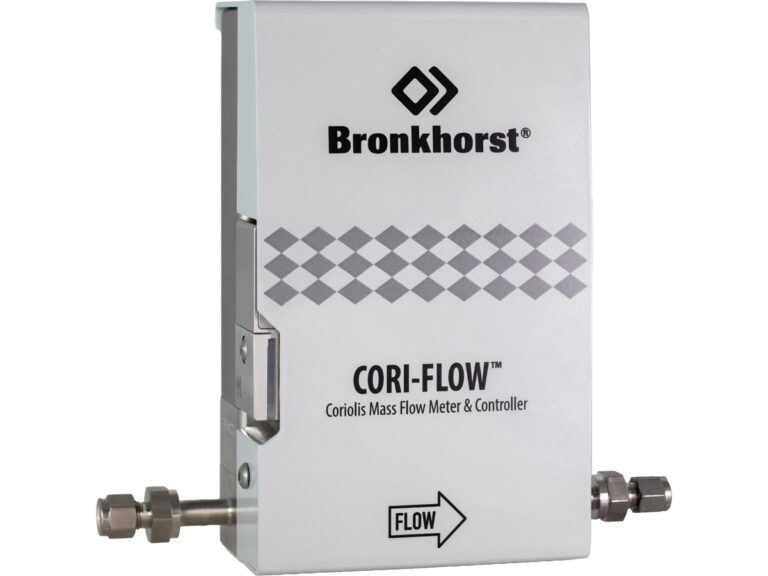
These measure mass directly. A Coriolis meter vibrates one or two tubes and reads the twist the flowing fluid causes, delivering mass flow, density and temperature at once, with accuracy around 0.1 % and no sensitivity to viscosity or flow profile. Thermal mass meters heat a sensor and measure how much heat the gas carries away, which suits low gas flows and leak detection. Both cost more per line and both dislike entrained gas or solids.
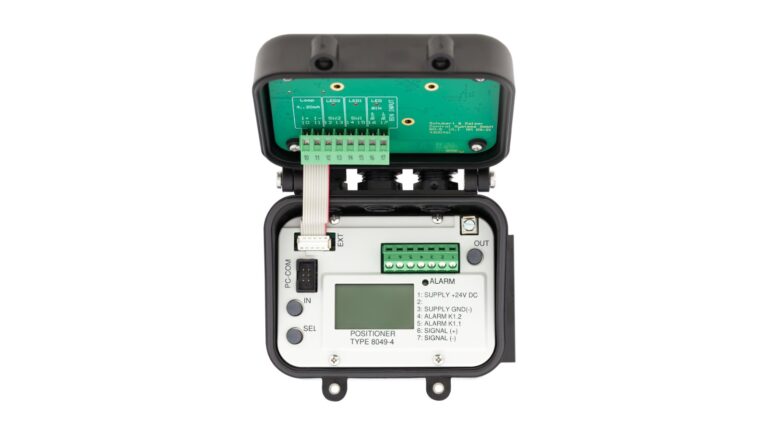
A meter on its own only reports. Flow control closes the loop: the transmitter feeds a controller, the controller drives a valve positioner, a variable speed drive or a dosing pump, and the loop settles at the setpoint. The slowest element decides the behaviour, so a fast meter behind a sluggish valve still gives overshoot. Mass flow controllers put sensor, valve and controller in one body and are standard for gas dosing in laboratories and semiconductor lines.
| Parameter | Typical range | Rule of thumb |
|---|---|---|
| Accuracy, liquids | Coriolis 0.1 %, electromagnetic 0.2 to 0.5 %, differential pressure 1 to 2 % of full scale | Percent of reading beats percent of full scale as soon as you run below half capacity |
| Turndown | Differential pressure 3:1, turbine 10:1, electromagnetic and ultrasonic 20:1, Coriolis 100:1 | Size on the lowest flow you must still measure, not on the highest |
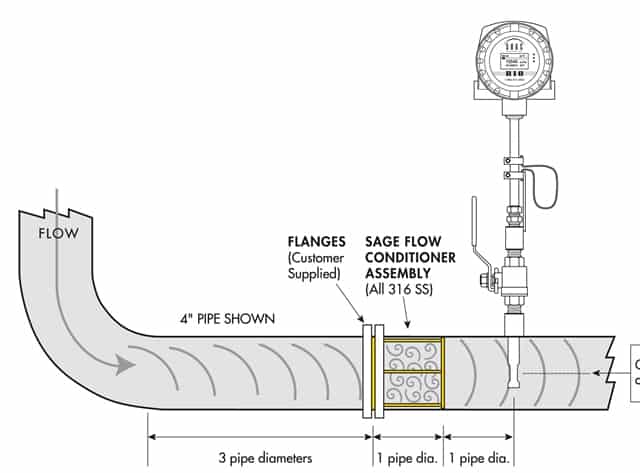
| Upstream straight run | 10 to 20 pipe diameters upstream, 5 downstream, for DP, turbine and vortex | Double it after two bends out of plane; Coriolis and electromagnetic meters need almost none |
| Pipe velocity, liquids | 1 to 3 m/s, up to 5 m/s for clean water | Below 0.3 m/s most meters lose accuracy; above 5 m/s erosion and noise rise fast |
| Conductivity, electromagnetic | 5 microsiemens per cm and up, special versions from 0.05 | Demineralised water, oils and most solvents will not work; pick another principle |
| Reynolds number, vortex | Above 20,000 for a stable vortex street | Viscous liquids drop below it at low flow and the meter simply stops reading |
| Permanent pressure loss | Orifice 0.5 to 1 bar, vortex 0.1 to 0.3 bar, Coriolis 0.2 to 1 bar, electromagnetic near zero | Add the loss to the pump duty before you choose; it is paid for every running hour |
| Response time in a control loop | Meter 0.1 to 1 s, valve stroke 2 to 10 s | Tune on the slowest element; damping on the meter hides noise but adds lag |
| Symptom | Likely causes | What to do |
|---|---|---|
| Reading is stable but consistently wrong | Wrong meter factor entered, nominal pipe size used instead of the real inner diameter, or the wrong density and reference conditions | Check the factory data plate against the transmitter settings and enter the measured inner diameter, not the nominal one |
| Signal jumps and the loop hunts | Partly filled pipe, entrained air, a pulsating positive displacement pump, or a meter sized far too large | Move the meter into a rising line or a low point, fit an air release upstream, add a pulsation damper, and check the meter is not running below a tenth of its range |
| Electromagnetic meter reads zero or wanders | Conductivity too low, empty or partly filled pipe, coating on the electrodes, or poor earthing | Verify the conductivity, guarantee a full pipe, clean the electrodes or switch to a capacitive type, and fit earthing rings or a proper bonding strap |
| Coriolis zero drifts after commissioning | Zeroed while flow was still passing, stress from the pipe supports, or a large temperature change since zeroing | Close both isolation valves, let the temperature settle, re-zero, and check that the meter carries no pipe weight or misalignment |
| Clamp-on ultrasonic loses signal | Air gap or dried couplant, a rough or corroded pipe wall, a liner thicker than entered, or gas bubbles in the liquid | Re-apply couplant, move to a clean section of pipe, enter the real wall and liner data, and stay away from the downstream side of a pump or valve |
| Turbine meter accuracy fades over months | Bearing wear, deposits on the rotor, or debris strikes in an unprotected line | Fit a strainer upstream, set a recalibration interval, and consider a meter without moving parts if the liquid stays dirty |
| Batches come out short or long | Valve closing time not compensated, damping set too high, or the flow ramped down too late | Set an in-flight compensation for the valve, lower the damping, and finish the batch with a slow dribble stage |
Go deeper: news and case studies · frequently asked questions
Equipment Guide
 Endress+Hauser AG
Endress+Hauser is a global leader in measurement instrumentation, services and solutions for industrial process engineering. We provide process solutions for flow, level, pressure, analytics, temperature, recording and digital communications, optimizing processes in terms of economic efficiency, safety & environmental impact.
Endress+Hauser AG
Endress+Hauser is a global leader in measurement instrumentation, services and solutions for industrial process engineering. We provide process solutions for flow, level, pressure, analytics, temperature, recording and digital communications, optimizing processes in terms of economic efficiency, safety & environmental impact.
 Panametrics
 offers solutions for measuring and analyzing moisture, oxygen, liquid, steam, and gas flow with proven technologies that are well-known and widely deployed across many industries, including oil and gas.
Panametrics
Panametrics offers solutions for measuring and analyzing moisture, oxygen, liquid, steam, and gas flow with proven technologies that are well-known and widely deployed across many industries, including oil and gas.
 Sage Metering
 is a manufacturer of high-performance thermal gas flow meters for gas flow measurement. Our NIST-traceable mass flow meters increase productivity, reduce energy costs, maximize product yields, and tackle ecological applications.
Sage Metering
Sage Metering is a manufacturer of high-performance thermal gas flow meters for gas flow measurement. Our NIST-traceable mass flow meters increase productivity, reduce energy costs, maximize product yields, and tackle ecological applications.
 Fluid Components International LLC
FCI designs and manufactures thermal mass flow meters, flow switches and level switches for industrial process measurement applications utilizing patented thermal dispersion flow measurement technologies.
Fluid Components International LLC
FCI designs and manufactures thermal mass flow meters, flow switches and level switches for industrial process measurement applications utilizing patented thermal dispersion flow measurement technologies.
 Titan Enterprises Ltd
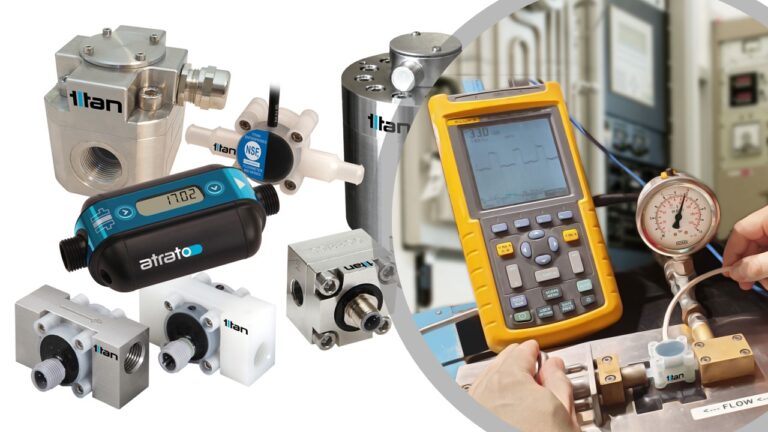
Titan Enterprises design & manufacture high quality, high performance, precision liquid flowmeters. Titan’s ultrasonic, oval gear & turbine flow meters, including NSF-approved devices, meet liquid flow control demands across industry sectors. The parameters & technology of Titan’s flowmeters fulfil application specifications of a broad scope of industrial processes, batching, laboratory & hazardous environments.
Titan Enterprises Ltd
Titan Enterprises design & manufacture high quality, high performance, precision liquid flowmeters. Titan’s ultrasonic, oval gear & turbine flow meters, including NSF-approved devices, meet liquid flow control demands across industry sectors. The parameters & technology of Titan’s flowmeters fulfil application specifications of a broad scope of industrial processes, batching, laboratory & hazardous environments.
 VPInstruments
 helps industrial companies gain easy insight into energy flows. Its solutions for compressed air, gas, and electrical energy monitoring enable users to identify losses, reduce costs, and optimize production utilities. With VPVision monitoring software, users can see exactly where, when, and how much energy can be saved.
VPInstruments
VPInstruments helps industrial companies gain easy insight into energy flows. Its solutions for compressed air, gas, and electrical energy monitoring enable users to identify losses, reduce costs, and optimize production utilities. With VPVision monitoring software, users can see exactly where, when, and how much energy can be saved.
 Industrial Tomography Systems (ITS/ITOMS)
Providing comprehensive process data and visualisations in real-time, electrical tomography is able to monitor virtually any academic research or industrial application involving mixing, separation, level detection, or flow rate; to facilitate greater process efficiencies and lower production costs.
Industrial Tomography Systems (ITS/ITOMS)
Providing comprehensive process data and visualisations in real-time, electrical tomography is able to monitor virtually any academic research or industrial application involving mixing, separation, level detection, or flow rate; to facilitate greater process efficiencies and lower production costs.
 Siemens Industry, Inc.
Siemens Process Instrumentation offers innovative measurement solutions to increase plant efficiency and enhance product quality. Siemens extensive portfolio of process instruments for flow, level, pressure and temperature measurement, provides critical data that enables you to optimize your process, reduce energy consumption and ensure safety.
Siemens Industry, Inc.
Siemens Process Instrumentation offers innovative measurement solutions to increase plant efficiency and enhance product quality. Siemens extensive portfolio of process instruments for flow, level, pressure and temperature measurement, provides critical data that enables you to optimize your process, reduce energy consumption and ensure safety.
Ask the Expert
Engineers and product specialists who answer technical questions from readers. The answer comes back to you by e-mail; when we publish it, other readers benefit too.
 Casey Williamson
GF
Casey Williamson
GF
Casey Williamson is Head of Business Development Microelectronics Global Industries for Georg Fischer. For the last 25 years, he has provided support…
Ask a question Dietmar Saecker
Endress+Hauser AG
Dietmar Saecker
Endress+Hauser AG
Dietmar Saecker is temperature measurement expert at Endress+Hauser in Nesselwang, Germany. His experience covers technical sales support, consulting for difficult temperature measurement…
Ask a question Paul de Waal
Vögtlin Instruments GmbH
Paul de Waal
Vögtlin Instruments GmbH
Paul de Waal is Dutch and educated as a Measurement and Control /Electronics Engineer. After a start as Instrumentation Engineer at Delta…
Ask a question Ryan Fitzgerald
Anderson-Negele
Ryan Fitzgerald
Anderson-Negele
Ryan Fitzgerald, Product Manager at Anderson-Negele, is an expert for the process management sensor portfolio which includes electromagnetic flow meters, Coriolis flow…
Ask a questionMarket & Technology Focus
Every Thursday edition takes one market or technology in depth. These are the editions on this zone — read them online or get the next one by e-mail.
Join 36,000+ engineers, plant managers and technical buyers who follow powder and bulk solids technology with us. Free, twice a week.
Questions and answers
Electromagnetic and Coriolis meters have no obstruction and no moving parts in the stream, so grit and fibre pass through instead of wearing down a turbine or blocking an orifice plate. An electromagnetic meter needs a conductive liquid and a full pipe, which sludge lines and return flows normally give you. Most of the field experience with this sits in wastewater processing, where meters run for years between calibrations.
Volumetric meters read a different number every time pressure or temperature moves, so hydrogen is normally measured as mass. Coriolis and thermal mass meters give mass flow directly, and the small molecule size makes sealing and material choice as important as the meter itself. Hydrogen processing plants specify on mass for exactly this reason.
It has to survive caustic and hot water cycles, drain fully, and leave no crevice where product can sit, which rules out most insertion meters. Hygienic electromagnetic and Coriolis meters with 3-A or EHEDG approval are the usual answer, welded or clamped into the line. The same requirement drives equipment choice across food, beverage and pharmaceutical plants.
A differential pressure or turbine meter reads a distorted profile as a different flow rate, so the rule of thumb is ten to twenty diameters upstream and five downstream, and more after two bends out of plane. Coriolis and electromagnetic meters are far less sensitive, which is why they win where the pipework is cramped. Retrofits in power generation often come down to exactly this trade-off.
The meter tells you what is happening; the control valve, the pump drive or the controller decides what happens next, and the loop is only as good as its slowest element. A fast meter behind a sluggish valve still gives you overshoot, so the two are specified together. Batching and dosing lines in chemical plants show how tight that pairing has to be.
That depends on the service and on what a wrong reading costs, not on a fixed rule. A Coriolis or electromagnetic meter in clean service can hold its calibration for years and is often only verified in place; a turbine or differential pressure meter in dirty or abrasive service drifts and deserves a yearly check. Custody transfer follows its own legal intervals. Built-in verification catches most faults in between.
Yes. Clamp-on ultrasonic meters sit on the outside of the pipe and measure through the wall, which makes them the standard choice for temporary surveys, for lines that cannot be shut down, and for checking an existing meter. Accuracy is lower than a wetted meter, typically 1 to 3 %, and it depends on knowing the wall thickness, the liner and the pipe material. For permanent custody-grade measurement a wetted meter still wins.
The zone is the editorial side: news, case studies, videos, newsletter editions and field experts. The Equipment Guide is the directory side: equipment types and the manufacturers that build them. This page links to its Equipment Guide category and back.
Open the Equipment Guide category for this zone, pick an equipment type and open a manufacturer profile. Partner profiles carry direct contact details; other listings link to the company website.
Yes. Ask the Expert puts your question to a field expert in this zone. The answer comes back to you by e-mail; when we publish it, other readers benefit too.