





- Missing WasteThat is at least a tenth more than factories report, and possibly more than 40 per cent more.
- Per PersonBetween three and ten litres of milk, beer and juice for every person in the EU, every year
- Binding TargetSince October 2025, Europe’s food manufacturers must cut their food waste by ten per cent by 2030.
Up to 4.6 Million Tonnes Leave with the Water
Tampere, Finland, 29 September 2026. Every dairy, brewery and juice plant in Europe knows the arithmetic. A hundred million litres a year come in through the tanker bay. Ninety-seven million, sometimes fewer, leave in cartons, bottles and cans. The rest went down the drain, mixed with the water used to rinse the pipes between one product and the next.
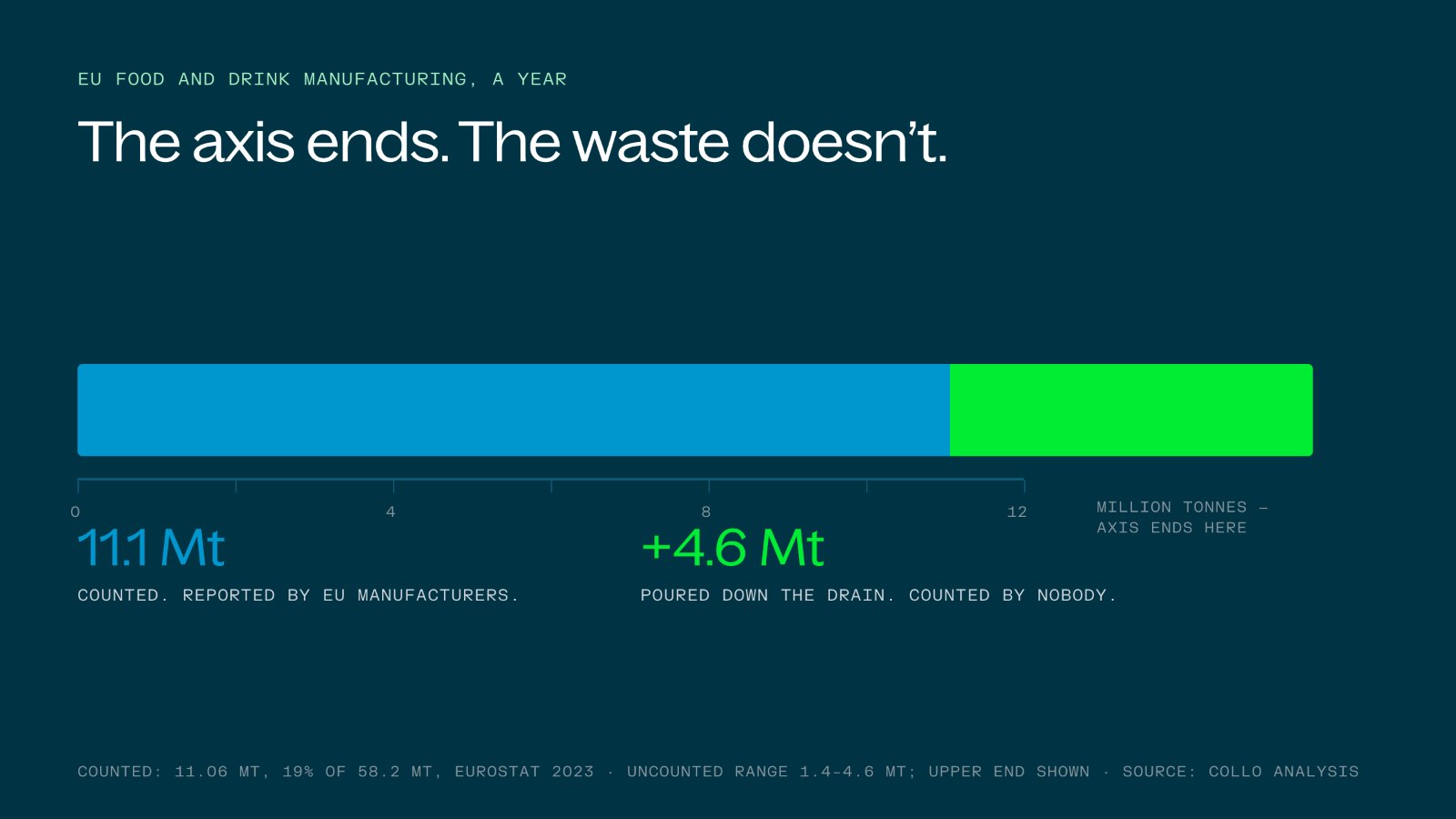
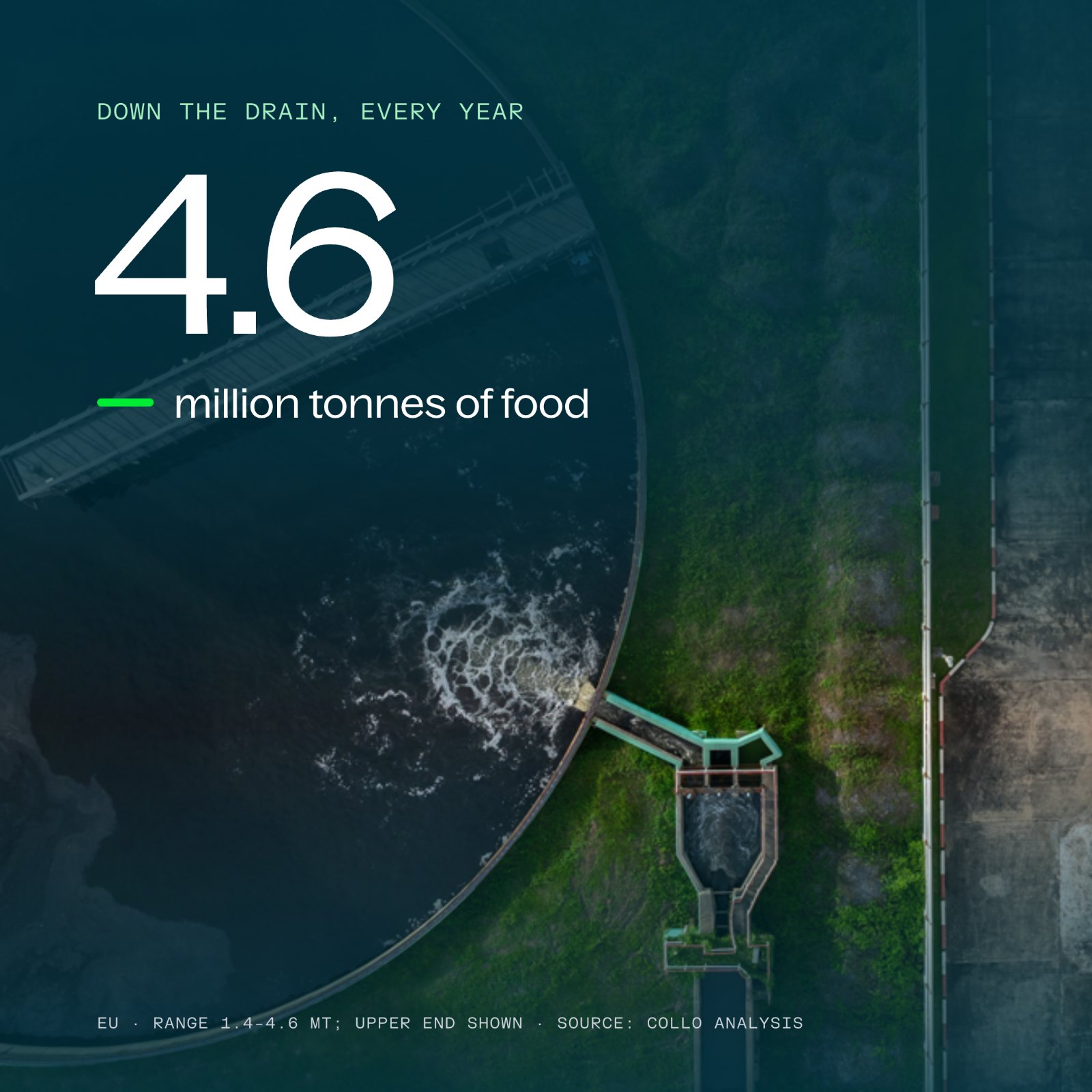
Across the EU, that leftover adds up. Figures published today by Eurostat put the bloc’s food waste at around 58 million tonnes in 2024, about 129 kilos per person. But the official number does not include anything that leaves a factory with the wastewater. An analysis using the European Commission’s own loss rates and Eurostat’s production data suggests that missing waste is between 1.4 and 4.6 million tonnes a year. That is at least a tenth more than factories report, and possibly more than 40 per cent more.
Put another way, it is between three and ten litres of milk, beer and juice for every person in the EU, every year, poured away before any of it reaches a shop. The milk alone would be worth between €320 million and €1.3 billion a year, before anyone turned it into cheese or yoghurt. Even on the most cautious reading (drinking milk and cheese only, using nothing but the Commission’s own loss rates), it is more than half a billion litres of milk a year.
A Rule Written for 2019
The reason none of it counts is an EU decision from 2019. When the EU agreed how to measure food waste, it ruled that food “drained as or with wastewater” would be left out, because at the time nobody could measure it reliably. That rule now sits underneath a binding target: since October 2025, Europe’s food manufacturers must cut their food waste by ten per cent by 2030. The one loss most liquid-food plants could actually cut is the one the target cannot see.
“Every plant knows how much,” says Jani Puroranta, chief executive of Collo, the Finnish sensor and analytics company that carried out the analysis. “A hundred million litres in, ninety-seven million out. The difference went down the drain, and it shows up in the mass balance. At least half of it, if not more, could be avoided and recovered with today’s technology. What nobody could do in 2019 was measure it as it happens, litre by litre, so you could stop it. The EU’s measurement rules were written in 2019, when that technology did not exist. It exists now.”
Nothing Dramatic Ever Happens
Spoilage and quality rejects are already kept to a minimum in every plant I know. The loss a factory can still reduce significantly is the one that leaves with the water. That is precisely the one the new EU target ignores. So what, exactly, are companies supposed to reduce by ten per cent?
Jani PurorantaChief executive of Collo
The losses are rarely spectacular. A valve switches 30 seconds late when a line changes from one cream batch to another. A cleaning rinse runs longer than it needs to. A batch is cut off early to protect quality, with an over-cautious safety margin. Each sends a few hundred litres to the drain. Over a year, at one European dairy handling 245 million litres of milk, it added up to as much as five million litres, with no alarm ever sounding and the monthly figures looking like business as usual.
Europe is not alone. The United States counts food sent down the sewer as waste in principle, but its Environmental Protection Agency has no figures for it from food manufacturers. Britain counts the sewer for households, not for factories.
There Is Already a Box for It
The EU’s reporting form has a column for food drained with wastewater. Filling it in is voluntary, and no country’s figures have been published. Governments writing the 2030 target into national law before June 2027 can ask their processors for the number now, and the Commission’s review of the targets, due by the end of 2027, can take it into account. Nobody is asking for new targets, only that the missing waste be measured and counted.
“The law was written for the technology of 2019,” Puroranta says. “Legislation moves in ten-year cycles; measurement has moved faster. The next review is the moment to catch up.”