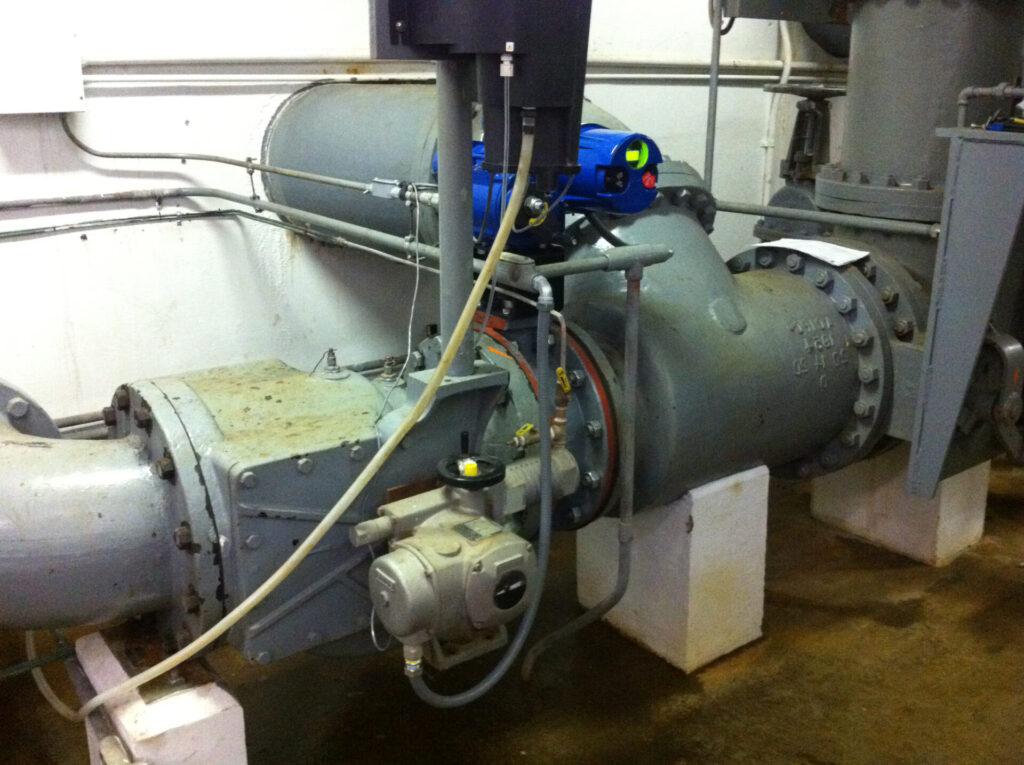




The benefit of this “direct acting ROFC” was: short laying length; complete control and metering system in one component; acceptable accuracy of +/-2.0-3.0% of rate; acceptable cost. Over time, performance issues developed due to wear on the valve portion of the system and, eventually, manufacturers who originally sold these devices either went out of business or stopped supporting the product.
Project History
Our client is a mid-size water system that had installed (8) direct acting filter effluent rate controllers in the 1950’s and came to PFS for replacements. Prior to discussing their issues with PFS, they had approached several manufacturers of magnetic flow meters and both had declined due to the complexity of the installation as well as their lack of hydraulic metering/control expertise that is a significant part of designing a properly performing rate controller.
Installation Conditions
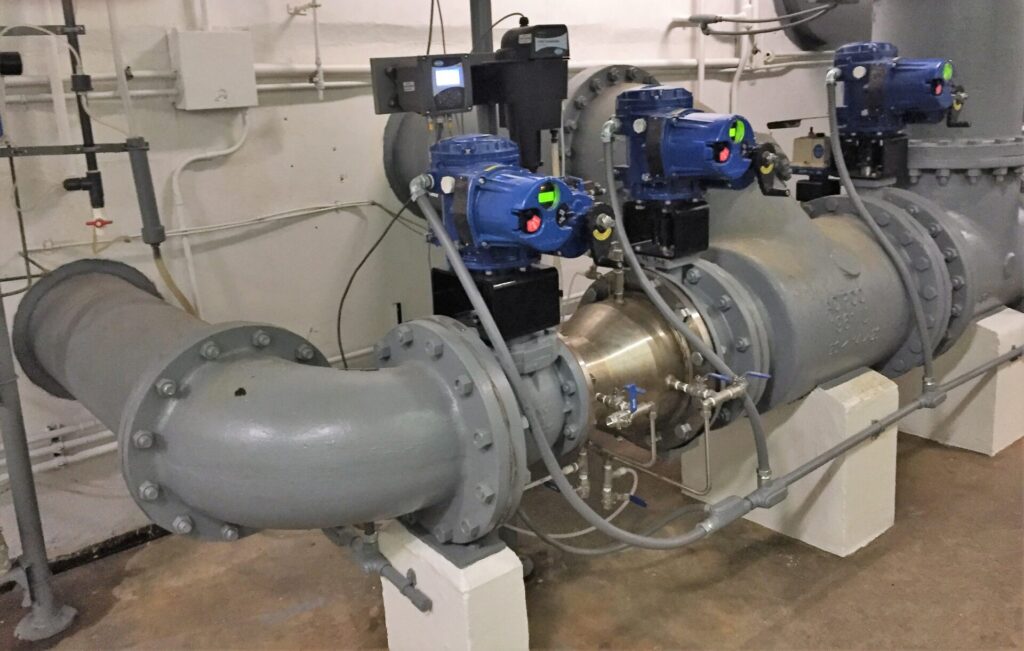
While typical filter effluent rate of flow controller installation are always less than ideal (from the piping point of view) this one was significantly more difficult because the client wanted both an upstream isolation butterfly as well as a downstream modulating control valve for rate control – and – all of these components had to fit within the footprint of the prior, very short, direct acting rate controllers.
Design Process
PFS studied the various input variables involved with proper rate control design and developed a solution which included an all stainless steel venturi meter, an upstream butterfly valve that was direct coupled to the inlet flange of the venturi meter as well as a plug valve (for modulating control) which was located on the discharge flange of the venturi meter (see the before and after photo’s below). Note that PFS utilizes a variety of valve types which are selected for ideal modulating flow control and, in this case, a plug valve provided the optimal solution.
Proof of Performance
Because of the piping configuration as well as the direct coupled valves, PFS built one complete test unit (including the upstream and downstream piping conditions) and independently laboratory flow calibrated the system at Utah Water Research Laboratory (UWRL). The PFS commitment to our customer was simple – we will build a complete metering system and calibrate it with customer witnesses in order to prove the perfect performance of the system. If, for any reason you are not satisfied with the controller’s performance, you will not pay for anything.
Upon delivery of the 8 systems, PFS Field Technical Services provided on-site start-up and training along with our standard 25-year warranty on the metering portion of the system.
The PFS Commitment to All of our Clients
For over 35 years, PFS has provided unequalled design engineering, hydraulic analysis and metering solutions for the worldwide water and wastewater market. We support all types of venturi meters including those manufactured by companies who are no longer in business or lack the technical expertise to resolve issues.