





In this article, we’ll cover the basics of compressed air leak management and explain why permanent monitoring is the foundation of a successful program.
Compressed Air Leak Detection Tools: Helpful, but Not the Whole Solution
Most people are familiar with leak detection tools.
There are many options on the market:
- Ultrasonic DetectorsSimple ultrasonic detectors with headphones
- Handheld DetectorsAdvanced handheld detectors with visualization
- Acoustic CamerasHigh-end acoustic cameras that show leaks in real-time
- Smartphone-Based SolutionsSmartphone-based solutions that can attach to your phone
Prices range from a few hundred dollars to tens of thousands for the most advanced acoustic cameras. But the question is: are they worth it?
Effectiveness Depends on the Person Using It
As with any measurement tool, effectiveness depends partly on the person using it. Basic ultrasonic detectors require experience to interpret sound correctly. Acoustic cameras make detection easier by visualizing the source of a leak, but they are not foolproof either. Reflected sound, for example, can create hotspots that appear to be leaks when they are not.
For many facilities, a simple entry-level leak detector is enough to get started. The biggest step is going from hearing nothing to suddenly discovering leaks throughout the system. Quantifying the leak exactly with a leak detector still involves a lot of “black magic”, compared to finding water with a dowsing rod, so don’t worry too much about the exact numbers. You will learn over time how to distinguish large leaks from smaller ones.
But this raises another question: Where should you start looking?
Finding Leaks in a Complex Compressed Air Network
In many factories, the compressed air network looks like a bowl of spaghetti. Pipes run across buildings, machines, and departments. In large plants, a full leak inspection can take days or even weeks and finding a leak can be like looking for the needle in the haystack. This is where permanent monitoring using flow meters becomes extremely valuable. By installing a flow meter, ideally one that measures flow, pressure, and temperature, you gain immediate insight into system behavior.
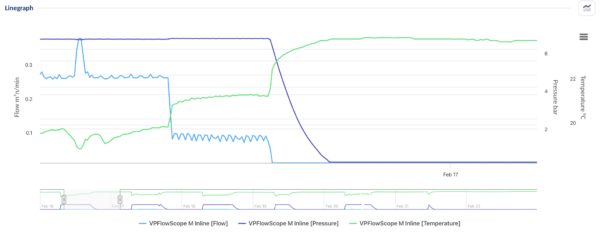
For example, leak load can be found during lunch breaks or shift/ job changes, or just before the start of the overnight shutdown or on Friday afternoon, before the weekend. During these time slots, production stops, but if the flow meter still shows air consumption, you instantly know that air is leaking. And now you can quantify the problem.
Translate Compressed Air Losses into Money
Once idle flow has been measured, it can be translated into energy use and financial cost.
If you install multiple flow meters across departments or machines, you can even determine:
- Highest Leak LoadWhich department has the highest leak load
- Job Changes and Idle TimeWhich machines are wasting the most compressed air during job changes and idle time
- Maintenance FocusWhere maintenance efforts should be focused
When you convert leak flow into €/year or $/year, the results can be shocking. In many factories, leaks represent tens of thousands of dollars/ Euros per year. And showing this number to management is often the moment when leak management becomes a priority. Some monitoring systems like VPVision can even display live energy costs on the screen, making the impact visible in real-time. The moment that you can see dollars or euros ticking away, awareness changes dramatically.
From Leak Repair to Continuous Improvement
Permanent monitoring also allows you to track the effectiveness of leak repair campaigns, carried out by your internal team or by external service providers. After a leak repair project, simply compare the average air consumption before and after the repairs. If the baseline consumption drops, your team did a great job. If not, you know there is still work to do. And when it goes back up again, you know it is time for another round of maintenance.
This approach turns leak management from a one-time activity into a continuous improvement process, where you keep your energy consumption at the lowest possible level. This is also the main reason you should have a permanent monitoring system in place. This is the only way to stay ahead of energy waste as you can take timely measures.
An Unexpected Indicator: Dew Point
Interestingly, leak detection isn’t only about flow meters. A dew point sensor can also reveal hidden problems. In very dry systems, such as those using desiccant dryers with dew points around -80°C/ -110 F, an unexpected increase in dew point at the point of use can indicate air leaks pulling humid ambient air into the system. In that sense, dew point sensors can also act as your additional “canary in the coal mine” for system leakage.
Traditional Methods vs. Modern Monitoring
In the past, engineers used indirect methods to estimate leak load, such as pressure decay tests, compressor load/unload cycle analysis or pump-up time measurements. While these methods can work, they are often time-consuming and impractical, especially in large systems with high capacity compressors. Sometimes it can take hours or even days to determine the leak rate accurately. And it is often not practical running a 24/7 operation. A flow meter, on the other hand, provides instant insight.
Where Should You Start?
You don’t need to instrument the entire factory on day one.
A simple starting point is:
- Main Compressed Air HeaderIdentify the main compressed air header
- 3-in-1 Bidirectional Flow MeterInstall a 3-in-1 bidirectional flow meter
- VPVision or SCADAConnect it to VPVision monitoring software or your own SCADA system
- Baseline and Idle FlowTrack baseline consumption and idle flow
The installation does not necessarily have to be perfect from day one. Even when measurement conditions are not ideal, trend data can already provide useful insight into how compressed air consumption changes over time. And once you visualize air consumption and leaks, you often discover that there is a gold mine of energy savings hidden in your compressed air system.
Video: Hidden Gold Mine of Compressed Air
Want to Know How Much Your Compressed Air System Could Be Costing You?
VPInstruments can help you assess your current compressed air consumption and identify potential opportunities for improvement.