



Select the right type flow meter for your application
Is the air wet or dry? Is an In-line or probe style best for your application? Select the right technology and type to match your situation. Good practise is to plan for the normal (average) flow to be 50% to 75% of the meter’s full range. We do not recommend using a flow meter at < 10% of its full flow range. Whenever possible, select a flow meter that will operate near its midrange specification.
Make sure the air quality matches the flow meter
Regardless of type, any flow meter is sensitive to pollutants in the air. For example, sticky particles can adhere to a thermal mass flow meter and small abrasive particles can wear away the sensor surface over time. We recommend placing thermal mass flow meters in dry air downstream of all air treatment filters to prevent sensor degradation. Also, for differential pressure flow meters a combination of too much water and dirt can clog the sensor.
Create enough straight pipe length
A symmetric, fully developed turbulent flow profile is what is needed for accurate flow measurement. Check the piping table, which you can find in the flow meter’s user manual, for the minimum recommended pipe length. Make sure to install the meter at the recommended distance from bends, valves and other objects that can distort the flow profile. Also, be aware that the flow profile can change when velocity increases. As a rule of thumb, most manufacturers recommend a minimum of “20 times the pipe diameter” downstream of a 90-degree bend.
There are manufacturers that claim a shorter pipe length is adequate for their flow meter technology. But you cannot change the laws of physics and that is why we advise using the longest pipe length that is available before and after the flow meter.
Beware of temperature sweeps
If temperature changes rapidly, this can affect the measurement accuracy of the flow meter and extreme temperatures can shorten its service lifetime as well. Large temperature variations, which can be found downstream of malfunctioning desiccant dryers, should be avoided. It is also good practice to check the maximum temperature rating of your flow meter to make sure worst-case conditions, at the location where the meter is installed, will not overheat and damage the flow meter.
Make sure the compressed air flow meter is 4-in-1
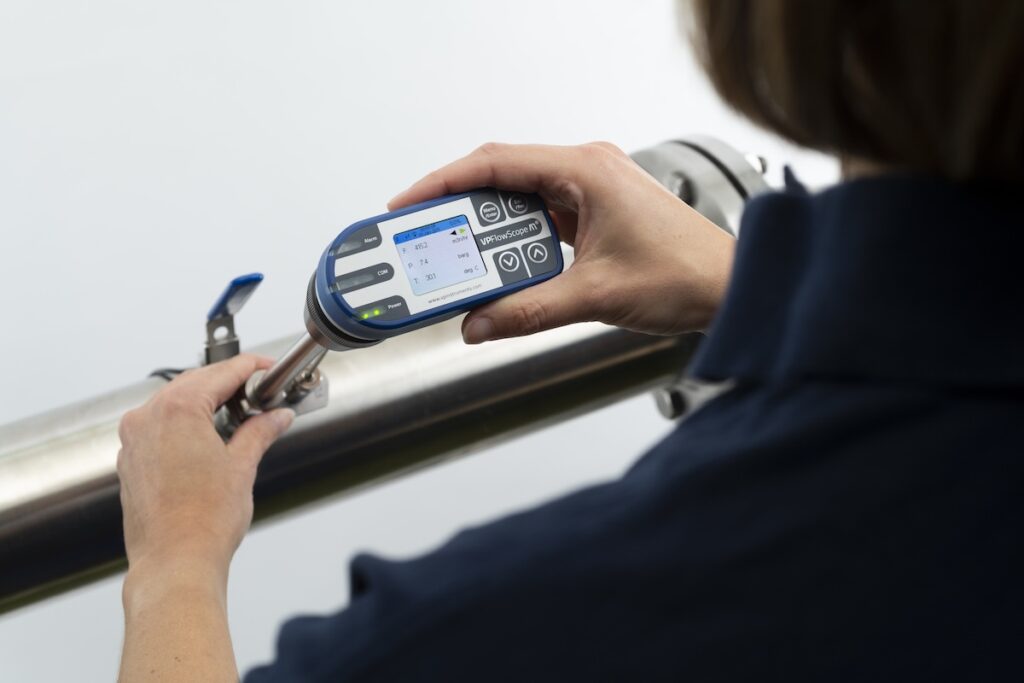
A regular thermal mass flow meter only measures mass flow. Without pressure and temperature, this does not give a clue about what is really going on. So, stop wasting your time looking only at flow, but get the complete picture. All VPFlowScope products, both thermal and differential pressure, measure flow, pressure, temperature, and totalized flow.
Be aware of reverse flow conditions
Flow in compressed air pipes can reverse direction unexpectedly, and only a bi-directional flow meter can reveal this. This is why all VPInstruments’ flow meters are equipped with a bi-directional sensor. Reverse flow can reveal issues with ring networks, multiple compressor rooms, non-return valves, leakage inside compressors, drains, filters and dryers. Measuring flow in both directions is crucial information for understanding your compressed air system.
Understand the effect of a receiver
Measuring flow and pressure before or after the receiver tank makes a big difference!
If you have multiple receivers, the situation becomes even more complex. If you do not take the receiver into account, you can draw the wrong conclusions about compressor capacity or equipment capacity. So, consider how the tank affects your system when measuring near receiver tanks, and be aware that a long pipe acts as a receiver as well.
Wet air flow meter: prevent flooding or excessive water
Measuring wet air in the discharge pipe of a compressor is possible with a differential pressure flow meter; but be aware of excessive water. It is important to check the water content of the system before installation of the flow meter and to check the flow meter a short time after installation. Signs of flooding are:
- Presence of condensate around the compressor on the floor
- Downstream issues with instrumentation
- Valves that are malfunctioning due to water
- Condensate spraying out of a ball valve near the compressor, when opened
- Malfunctioning or clogged filters
- Malfunctioning dryers downstream of a compressor
- Dew point issues
Wet air flow meter: install at the right angle
Flow meters used to measure wet air need to be able to drain excess water build-up, and gravity helps. Install the flow meter at a 30 to 45-degree angle in a horizontal pipe so water can easily drop off the meter’s tip. This installation angle will also make it difficult for water to enter the flow meter. Installation in a vertical pipe is not recommended and should be avoided. Installation in a vertical pipe, especially when there is excessive condensate in the pipe, can cause flooding of the sensor, which can lead to a meter malfunction or permanent damage.
Checklist
Before installing a flow meter, always check the following points:
- Flow (estimated): average flow, lowest and highest value. Any high frequency Changes expected?
- Pressure: min and max pressure should be compliant with the meter specifications.
- Temperature: min and max temperature and potential temperature sweeps?
- Gas / air type: wet air, dry air, argon, helium, nitrogen or another gas? Note that your flow meter can be calibrated for your technical gas for high accurate measurement.
- Vibrations: excessive vibrations can limit the lifetime of equipment and can also affect the wiring to the instrument
- Location: vertical/horizontal pipelines, up and downstream objects that might distort the flow.
- Measurement accuracy: how accurate do you need the flow measurement to be? Is it for trending or to get an exact measurement of the compressor capacity?
- Receiver tanks: be aware of the impact. To get the data you need, will you measure before or after the receiver tank?
- Required outputs: Modbus RS485, Modbus TCP (Ethernet), 4 to 20 mA or pulse?
- Data monitoring: what would you like to do with the data monitoring system? Automatic reporting? Alarms?
- Additions to make the system better: What additional sensors do you need to get a complete picture of your compressed air system? We recommend measuring at least flow, pressure, temperature and compressor power consumption. Add dew point when air quality is critical.