



Integrated sensors and a configurable flushing function support compliance with hygiene requirements while significantly reducing operating costs. At the same time, the system enables continuous monitoring of network conditions, significantly contributing to a safe and sustainable drinking water supply.
As demands for operational safety and drinking water quality in modern drinking water networks continue to rise, the role of traditional valves is undergoing a fundamental shift. Today, addressing individual functions in isolation is no longer sufficient. What is required are integrated solutions that combine hygiene safety and network monitoring into a single, holistic approach. To meet this need, the VAG DUOJET® @ON Smart Air Valve was developed and introduced as a production-ready solution at the IFAT trade fair in Munich in May 2026. It marks the next step in the evolution of a proven valve into an enhanced system component.
The core approach is to combine hygiene protection and network monitoring in a single valve. The traditional venting and air-release function is combined with an automated, hygienically effective flushing strategy. This ensures that areas within the drinking water system that are prone to stagnation are regularly flushed, thereby maintaining drinking water quality at a defined level at all times.
The flushing function is designed to run automatically at user-defined intervals – for example, every three months – and can be adapted to the specific system conditions. This helps ensure compliance with the hygiene requirements of DVGW W392-2 without requiring on-site service personnel to intervene. The manual flushing cycles that were previously required are no longer necessary. The process is repeatable and significantly reduces operational effort for work assignments.
Timo Bugert, Product Manager for Global Engineering at VAG, explains from a technical perspective: “The automatic flushing system integrates seamlessly into the system and offers not only hygienic benefits but also advantages in terms of maintenance and network operation. This integration establishes a reliable foundation for consistently reliable hygiene safety throughout the entire network.”
In addition to its integrated flushing function, the valve fulfills its core purpose as a single-chamber high-performance valve for the controlled venting and filling of piping systems. It combines three essential functions: venting during discharge, air release during filling, and continuous operational venting. The design enables the stable and efficient removal of both large volumes of air during dynamic operating phases and small amounts of air during continuous operation – even at air velocities approaching the speed of sound.
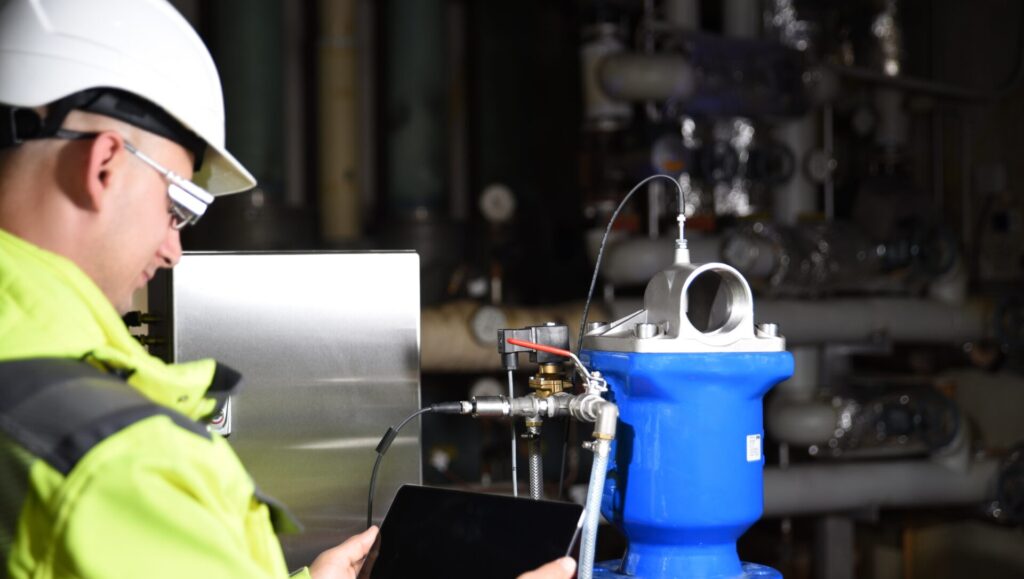
In addition, the smart valve enables continuous monitoring of relevant operating conditions. The integrated sensors and system controls measure pressure conditions and valve positions. This data is not collected in isolation but rather enables a reliable assessment of the system’s condition.
Upon request, operators receive both regular status updates and real-time alerts in the event of deviations from normal operation. The information gathered enables continuous monitoring of the condition of the pipelines and the manhole infrastructure. Pressure deviations, unusual operating conditions, or unauthorized access to the valve or the installation shaft can be detected early and transmitted to the network operator as status or warning messages. This advancement allows early detection of potential incidents, such as pipe breaks or critical operating conditions. The valve thus assumes a significantly enhanced role within the supply network.
Security is also a top priority when it comes to data transmission. Communication is unidirectional and encrypted. Only status and warning messages are transmitted from the field to the operator; external access to the valve is prevented. This ensures a high level of IT security.
The combination of a low-maintenance design – with operating periods designed for a minimum of three years without requiring on-site service – and integrated data capabilities supports compliance with the requirements of DVGW W392-2 and enables seamless integration into existing and future network structures. At the same time, it lays the groundwork for advanced applications such as condition-based maintenance or higher-level network analyses.
This approach demonstrates that the future of water supply does not depend on the isolated digitization of individual components, but rather on the intelligent integration of function and information. Only when the valve itself becomes an active information carrier does measurable added value emerge – both in technical and economic terms. In this way, the valve becomes an integral part of a resilient and sustainable water supply network.
To learn more about the VAG DUOJET® @ON Smart Air Valve and how it can enhance hygiene safety and operational efficiency in your network, visit vag-group.com or contact our experts for a personalized consultation.