





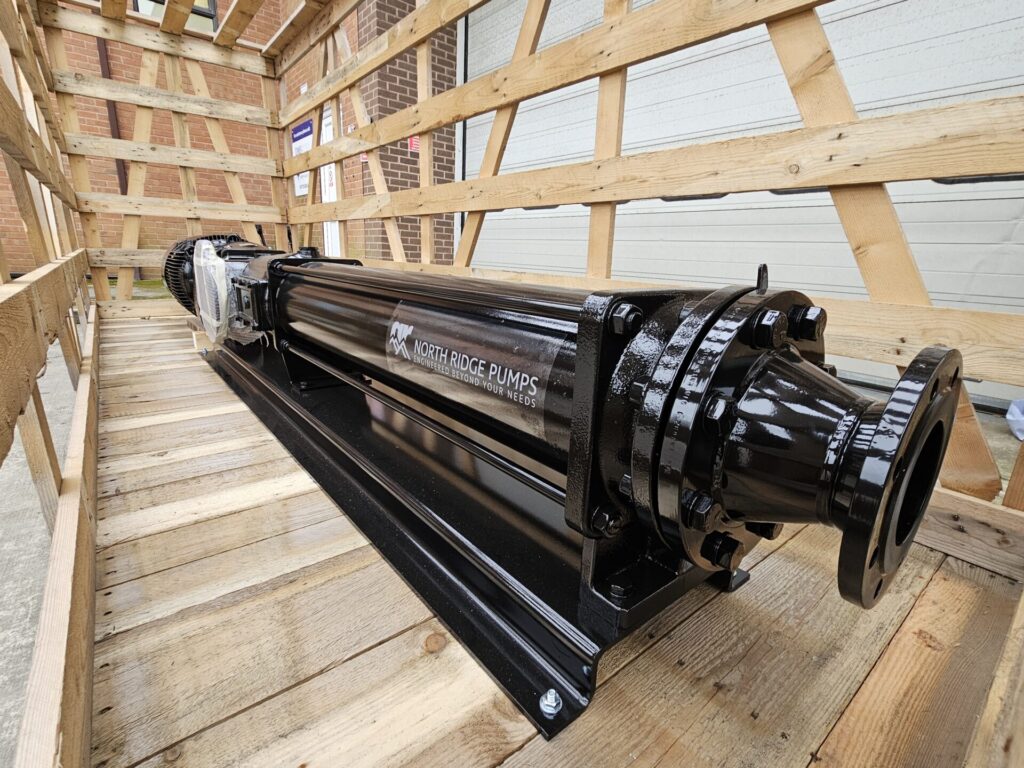
This fluid was a mixture of barite and bentonite similar in consistency to drilling mud. This would be pumped through a recirculation circuit for homogenisation, and required pressures up to 12 bar and varying flows up to 77m³h.
Barite and bentonite are both essential minerals used heavily in oil and gas drilling, but they have completely different compositions and functions. Barite is an ultra-dense mineral used to weigh down drilling fluids, while bentonite is an absorbent clay used to thicken the fluid and seal the wellbore in drilling operations.
Together, this combination makes a very thick fluid, which made our job much trickier. We had to make sure we came up with exactly the right pump specification.
In addition, the barite/bentonite combination created a mixture which behaved very differently to normal liquids.
Its viscosity and specific gravity were high when the fluid was stationary in a tank. However, as shear was applied its specific gravity and viscosity dropped significantly. The fluid changed from a thick paint-like substance into a free-flowing liquid.
The high-density slurry pump we specified would have to be flexible enough to handle both types of fluid.
Specific gravity affect on a pump’s performance curve
It’s because a pump’s flow rate is measured by volume. However, the specific gravity or density of the liquid being pumped can have a big impact on flow rate due to the pressure the pump must exert. It also increases the amount of power the pump needs to draw, which also affects performance and running costs.
Pump curves are usually based on water, which has a specific gravity of 1. If a liquid has a higher specific gravity, the pressure and power increases. If the liquid has a lower specific gravity, the pressure and power required decrease, so a smaller motor may be suitable.
Solids in the fluid also affect the amount of power demanded by the pump. Wastewater containing sewage is typically treated as having a specific gravity of 1 because it contains a high proportion of water. However, slurries like the one our client was transferring can be two or three times denser, increasing the motor power required.
If a liquid is viscous when standing still and not experiencing any shear, then a positive displacement type of pump is probably required if the viscosity at low or zero shear is more than 300cst. A centrifugal type of pump is unsuitable because its viscosity handling is limited to just 300cst.
High density fluids also affect the amount of power the motor needs and the pressure it has to develop. It’s therefore essential that the pump can handle the higher specific gravity to produce the pressure required, particularly if it’s a centrifugal type of pump design.
What was our pump specification?
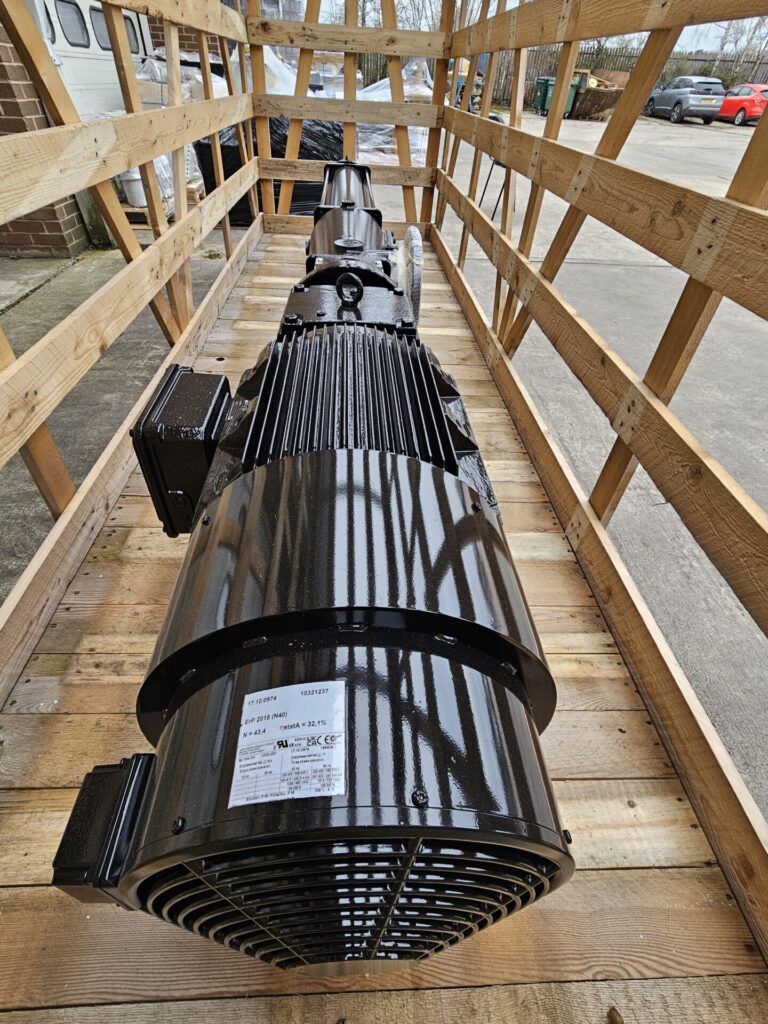
For this client’s demanding bentonite transfer application, we supplied our DN120K4, a heavy-duty industrial grade progressing cavity pump weighing in at over 1.1 tonnes and 3.9m long. Our whole DN range has a modular design which allows the main pump features to be used across a range of pump models from industrial through to hygienic applications.
The DN series also features a modular drive connection which enables pumps to be coupled directly to a drive, via a gearbox or lantern with a bearing housing if high pressures or 24/7 uptime are required.
This particular high-density slurry pump model can handle viscosities up to 10,000mPas and transfer liquids with specific gravities up to 3.
We assembled the unit with a 37Kw motor fitted with extra fan cooling. This enabled the pump to provide a wide range of flows proportional to speed. This was between 19 and 77m³h at low pump speeds of just 60 to 270rpm, ensuring that pump wear and tear was kept to a minimum.
A key component – the cardan joint
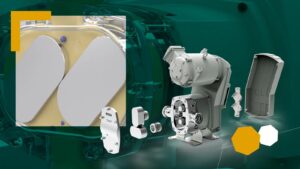
This is the joint in the pump head which transmits torque from the motor, gearbox and pump shaft to the pressure-producing part – the rotor.
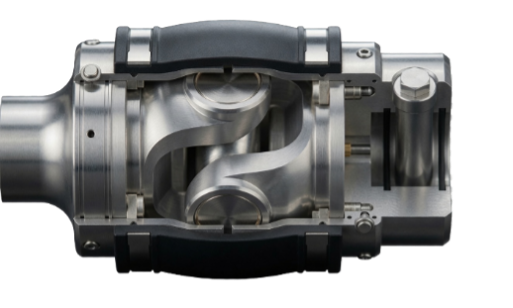
Widely known as a universal joint or U-joint, the cardan joint is a mechanical coupling that connects rigid shafts whose axes are inclined to each other. This allows the transmission of rotary motion and torque at an angle, making it highly effective for misaligned or flexible shaft set-ups.
The cardan joint in our bentonite transfer pump is designed without welded parts so it can withstand torque limits up to 4 times higher than the designed parameters. This also makes it suitable for handling applications where 24/7 operation is required, as well as pressures up to 48 bar.
If you have an application involving the transfer of high-density fluids, and need help to find the best solution, speak to North Ridge Pumps today.




