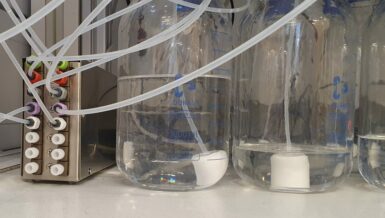

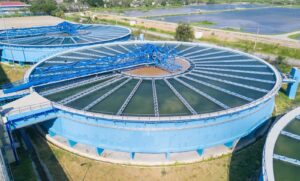




To develop such proteins in a targeted manner, microalgae are cultivated in small photobioreactors or laboratory fermenters. Here, growth conditions such as light, temperature, pH, and gas supply are crucial.
The secret of algae photosynthesis
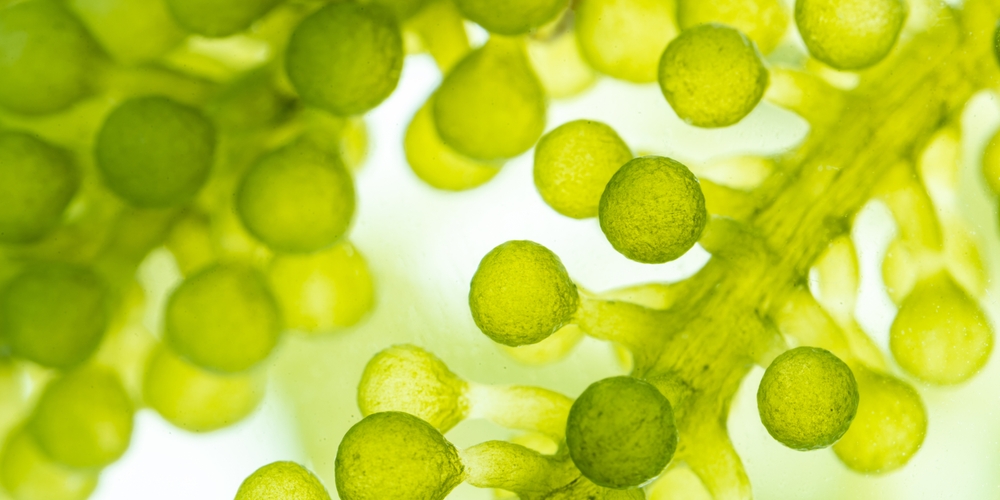
In algae cultivation – for example, in the production of protein-rich biomass – gas supply plays a central role, particularly CO₂ and air (oxygen):
- Microalgae carry out photosynthesis and use CO₂ for biomass and protein synthesis.
- The exchange of CO₂ and O₂ within a reactor significantly influences growth, metabolic rate, and product yield.
Mass flow meters and mass flow controllers (MFCs) are essential tools for the precise measurement and control of gas flows, as conventional mechanical flow meters are often too imprecise or dependent on pressure and temperature.
Specific applications:
- Controlling CO₂ supply for photosynthesis or aerobic processes in algae cultivation
- Regulating air or O₂ supply to control dissolved oxygen levels, ensuring optimal algae growth
- Ensuring homogeneity and reproducibility of cultures across different batches through stable gas flow rates
Particularly in highly sensitive bioprocesses – e.g. the development of new proteins from algal biomass or optimised fermentation – the precision of gas flow determines yield and quality.
The right hardware for precise processes
In a biotech project on microalgae cultivation, researchers used Vögtlin red-y smart thermal mass flow meters and controllers to precisely monitor and control CO₂ flows in the bioreactor. The result: reproducibly accurate measurements and improved process control compared to conventional flow indicators.
This applies to all biotechnological applications where:
- Fluctuations in temperature and pressure can affect gas flow
- Gas volumes and concentrations must be tightly controlled
- Process data needs to be recorded reliably and reproducibly
In a biotech project on microalgae cultivation, researchers used Vögtlin red-y smart thermal mass flow meters and controllers to precisely monitor and control CO₂ flows in the bioreactor. The result: reproducibly accurate measurements and improved process control compared to conventional flow indicators.
This applies to all biotechnological applications where:
- Fluctuations in temperature and pressure can affect gas flow
- Gas volumes and concentrations must be tightly controlled
- Process data needs to be recorded reliably and reproducibly
Precise gas control makes all the difference. With accurate MFM/MFCs, algae cultures become controllable, reproducible, and scalable – opening new avenues for innovative protein sources of the future.