






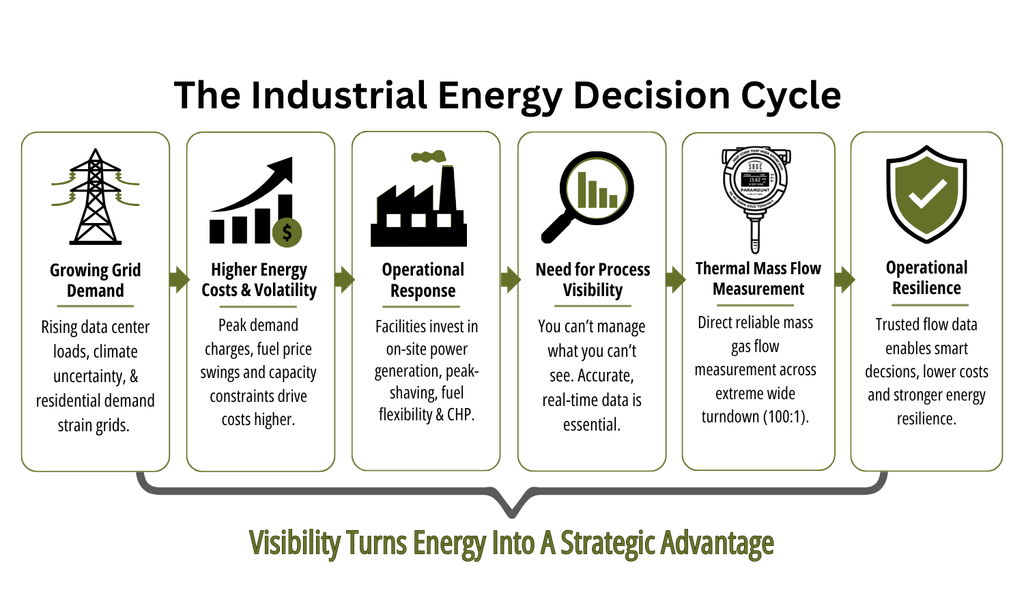
Recent reports from the International Energy Agency (IEA) and the U.S. DOE show data center electricity demand could double or triple in key regions by 2030, consuming anywhere from 9-15%+ of total U.S. power.
To satisfy these enormous energy demands, utilities and grid operators are leaning heavily on natural gas-fired power generation, and radically rethinking capacity planning, peak-demand management, and infrastructure expansion.
They aren’t alone. Industrial energy consumers, such as manufacturing hubs, wastewater treatment facilities, pharmaceutical plants, food process operations, and steel producers are experiencing their own downstream reality; an environment defined by grid volatility, rising peak tariffs, and potential rolling curtailments.
As a result, industrial facilities are under mounting pressure to take control of their own energy needs.
The Macro Shift: Improving Energy Resilience
To reduce the reliance on the grid and protect operating margins against rising energy costs, industrial leaders are increasing capital expenditure on alternatives and supplements. The strategies once considered secondary options are now frontline operational defenses:
- On-site generation to maintain baseload stability
- Peak-shaving to avoid exorbitant utility charges during peak grid hours
- Fuel blending/shifting (e.g. integrating hydrogen or renewable natural gas
- Combined Heat and Power (CHP) systems to maximize thermodynamic efficiency
The challenge then becomes how to deal with the increased physical demand placed on fuel supply lines when operating what amounts to a mini-power plant on a factory floor. When a facility ramps up on-site boilers, standby microturbines, or CHP units to cushion against grid strain, combustion lines undergo severe flow variations that range from whisper-low standby pilot levels to high-volume peak surges.
In dynamic operating conditions like these, traditional or static flow measurement devices can quickly become liabilities. Legacy differential pressure (DP) plates and volumetric meters struggle across wide turndown ranges and introduce parasitic pressure drops that force supply compressors to work harder.
Resilience Goes Beyond Efficiency
No matter the industry, true energy resilience starts with understanding exactly how much gas is being consumed in real-time, across all operating modes.
Along with investments that provide some energy independence from aging grids and steep price increases, there is a growing need for accurate, repeatable measurement.
Whether optimizing boiler combustion, balancing CHP systems, monitoring compressed air leaks, or verifying natural gas consumption, decision makers need accurate flow data to make well informed operational decisions.
Control Through Visibility
True operational control requires granular visibility. For decades, facilities managed utility costs using a single master meter at the fence line, and allocated energy costs across departments based on square footage or historical estimates.
With today’s high costs, treating energy as an unmeasured overhead expense creates major operational blind spots.
To establish precise process control and align with modern energy management standards like ISO 50001, facilities are expanding sub-metering deep within their plant networks.
- Compressed air line auditing: Compressed air is often referred to as a plant’s “fourth utility” and typically constitutes one of its highest operational expenses. Up to 30% of a plant’s compressed air can be lost to artificial demand and ultra-low flow pipe leaks. Thermal mass flow meters are ideal for detecting extremely low velocities without causing pressure drops. Inserting them into branch lines allows operators to pinpoint non-productive air usage and continuous baseline leaks during non-production hours.
- Cost center accountability: Placing dedicated insertion thermal mass gas meters on natural gas branch lines, nitrogen blanketing systems, and steam boilers converts unmetered utility overhead into precise, accountable cost centers. Plant managers gain the real-time visibility needed to measure cost-per-unit production accurately and detect process anomalies before they result in major energy waste.
Why Measurement Quality Matters
Smart decisions require trustworthy data and stable measurement; qualities inherent to thermal mass flow measurement. Along with capital investments that provide energy independence from again grids, there is a growing need for accurate, repeatable flow measurement:
- Handling extreme turndown in on-site power: Ramping-up use of on-site boilers and turbines requires a high-performance thermal mass flow meter, such as the Sage Paramount or Sage Prime. These meters handle extreme turndown ratios (100:1), measuring low standby pilot flows, up to massive full-load surges without losing accuracy, or adding parasitic pressure drop.
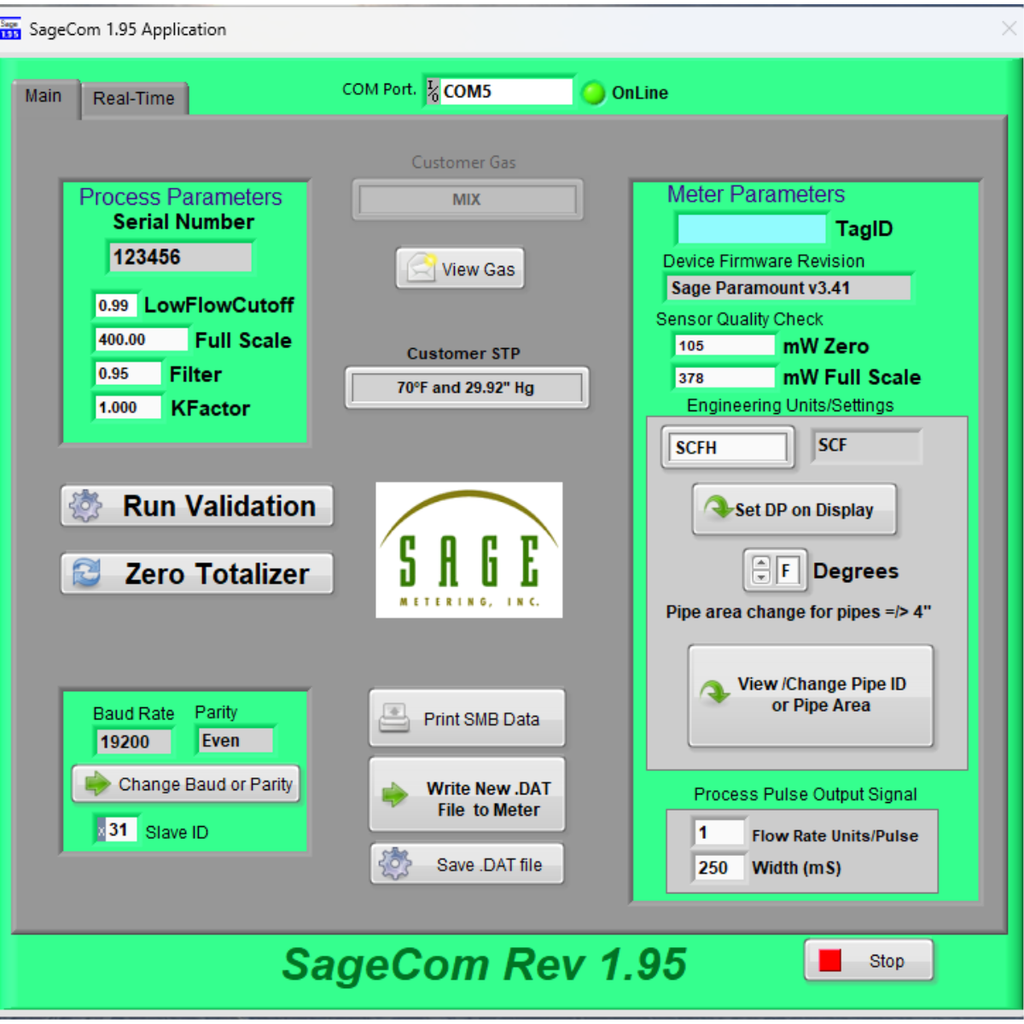
- Adapting to dynamic gas blends: Natural gas was standard pipeline quality ten years ago. Today, industrial facilities regularly blend natural gas with renewable natural gas (RNG), landfill gas or hydrogen to hit their decarbonization targets. Because gas properties vary by composition, traditional volumetric or differential pressure (DP) devices require complex, indirect calculations using additional temperature and pressure inputs. Whereas thermal mass flow meters provide a more direct mass measurement without external temperature or pressure compensation. Modern industrial processes also require measurement systems that can adapt as fuel compositions change. With advanced configuration tools like SageCom software from Sage Metering operators can easily update gas mix parameters and maintain calibration integrity directly in the field; eliminating the need to shut down processing lines or send meters back to the factory for recalibration.
Taking Back Control
Industrial operations cannot control increased AI infrastructure demand, energy markets, shifting utility rates or regional grid constraints, but they can control how well they understand and optimize their own processes.
Just as regional grid operators rely on sophisticated load forecasting and real-time metering to navigate unprecedented AI-driven power demands, industrial facility managers have to adopt the same mindset.
As energy becomes a more strategic production resource, investments in generation, efficiency and process optimization, make visibility evolve from a routine maintenance tool into a business advantage.
Industries that invest in accurate process measurement now will be better positioned to adapt to whatever challenge reshapes the energy landscape in the future.