



- Washing optimization
- Deprotection monitoring
- Coupling and reaction trend monitoring
- Solvent transition and process consistency
Making Peptide Synthesis More Measurable and Controllable

Process engineering, manufacturing and MSAT (Manufacturing Science and Technology) teams are facing the challenge of making peptide synthesis more measurable and controllable without adding unnecessary analytical complexity. Inline refractive index (RI) monitoring offers a wide range of advantages in Process Analytical Technology (PAT), and in the following article, Tamara Murusidze from Vaisala will discuss these in application specific contexts.
Why Refractive Index?
RI is a direct physical measurement related to the concentration and composition of dissolved material in the liquid phase. In peptide synthesis, many process steps involve changes in the liquid surrounding the resin: reagent introduction, coupling, deprotection, byproduct formation, solvent exchange, and washing. As these liquid-phase concentration profiles change, the RI signal also changes. This makes RI useful not as a molecular identification tool, but as a continuous process fingerprint.
Practical applications for RI monitoring include:
- Reagent and Solvent Transitions
- Coupling and Deprotectionconcentration changes during coupling and deprotection
- Wash-Out Profileswash-out profiles after reaction steps
- Endpoint Behavior
- Process Trendsdeviations from expected process trends
- Consistencybatch-to-batch or scale-to-scale consistency
RI as a Process Analytical Tool for SPPS
RI was evaluated by B.G. de la Torre et al (1) as a process analytical tool (PAT) for the real-time monitoring of SPPS to determine the endpoint of reactions and to optimize the use of reagents and solvents to deliver a more sustainable SPPS process. The benefit of RI technology is that it adds direct continuous visibility to the peptide synthesis process.
Where Does RI Add Value to Peptide Synthesis?
Real-time visibility of liquid-phase composition can provide valuable insights into a variety of stages in peptide synthesis. For example:
Washing Optimization
Washing steps are often intentionally conservative because of limited real-time information on when residual reagents, byproducts, or solvents have been sufficiently displaced. RI can provide a continuous wash profile, helping teams understand when the liquid phase has returned to the expected baseline.
This supports more rational wash development and may reduce unnecessary solvent use without exposing proprietary process details or relying only on fixed time/volume assumptions.
Deprotection Monitoring
During Fmoc deprotection, the liquid phase composition changes as deprotection progresses and reaction products are removed. RI can follow these bulk concentration changes in real-time, supporting better understanding of deprotection kinetics and step completion. This is especially valuable during development, troubleshooting, and scale transfer, where the comparison of real-time profiles may reveal whether a process is behaving consistently across equipment, resin lots, solvent systems, or operating conditions.
Coupling and Reaction Trend Monitoring
Coupling reactions involve the uptake and consumption of dissolved reagents by the solid phase. While RI is not selective to a single molecule, it can still provide useful insight into process trends that are reflected by changes in the surrounding liquid phase. This may help identify abnormal reaction behavior, delayed mass transfer, incomplete displacement, or unexpected process drift. Used together with established offline analytics, RI can become a practical tool for building process understanding without requiring complex chemometric models.
Solvent Transition and Process Consistency
Modern peptide manufacturing increasingly explores greener solvent systems, solvent reduction, recycling, flow-based synthesis, and alternative process intensification strategies. In these contexts, real-time visibility of liquid-phase composition becomes even more important. RI can support monitoring of solvent transitions, wash consistency, and process reproducibility across development, pilot, and manufacturing scales.
Need for Real-Time Process Information
Recent work in peptide manufacturing shows a clear direction: the industry is moving toward greener, faster, more data-rich processes. Studies on wash reduction, greener solvents, Raman-based monitoring, computer vision, and intensified synthesis platforms all point to the same need: better real-time process information. However, not every manufacturing environment needs a complex spectroscopic model. In many cases, the immediate need is a robust, scalable, easy-to-integrate signal that helps operators and process teams understand whether the process is progressing as expected. This is where inline RI can be attractive: it is universal, real-time, continuous, stable, and comparatively simple to implement.
Practical Implementation Considerations
Successful RI implementation requires application-specific evaluation. Important factors include solvent system, temperature behavior, installation point, process pressure and flow conditions, baseline definition, and the intended use of the signal.
For GMP implementation, RI should be positioned as a complementary PAT signal supporting process understanding, endpoint detection, and process consistency. It does not need to disclose or depend on proprietary reaction recipes to deliver value. A good start is to begin with development-scale process profiling, comparison of RI trends with existing analytical data, and then definition of where the signal provides practical decision-making value.
Measurement Technology Should Be Drift- and Maintenance-Free
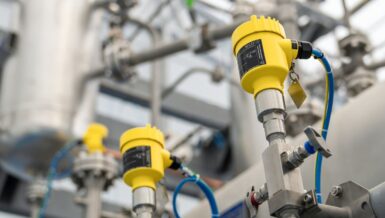
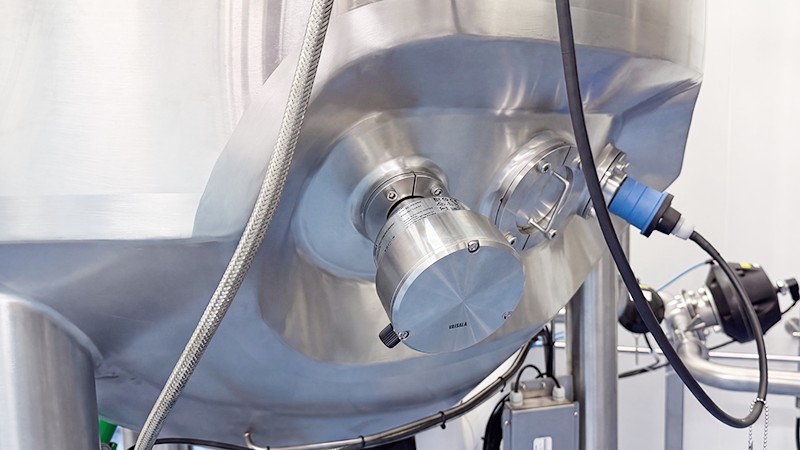
Vaisala Polaris™ process refractometers are designed for continuous industrial liquid measurement in demanding process environments. Their robust optical design, with no moving parts, a compact sensor body, and a stable digital measurement principle make them well suited for inline monitoring in peptide manufacturing environments.
Integrated temperature measurement and compensation support reliable trending during changing process conditions. Multiple mounting options allow installation in development, pilot, and manufacturing systems, while ATEX-certified configurations are available for solvent-based and hazardous-area applications.
The instrument can be integrated directly into automation systems as a standalone sensor or used together with a Vaisala Indigo transmitter for local visualization, diagnostics, configuration, and user-friendly operation. This flexibility allows process teams to apply the same measurement principle from early process development to commercial manufacturing, supporting scale-up, process understanding, and digitalization without adding unnecessary analytical complexity.
Summary
As peptide manufacturing moves toward greener, more efficient, and more data-driven production, the need for practical and scalable PAT tools continues to grow. Inline refractive index monitoring can offer a simple and robust way to improve real-time process visibility during peptide synthesis, supporting better process understanding, solvent optimization and manufacturing consistency.
Reference
(1) Refractive Index: The Ultimate Tool for Real-Time Monitoring of Solid-Phase Peptide Synthesis. Greening the Process. Beatriz G. de la Torre, Shaveer Ramkisson, Fernando Albericio, and John Lopez. Organic Process Research & Development 2021 25 (4), 1047-1053 DOI: 10.1021/acs.oprd.1c00051