




This fact alone has made ERT incredibly versatile to the point where it has become an indispensable tool for academics and researchers in a raft of scientific disciplines including chemistry, chemical engineering, food science, and petroleum engineering – to mention just a few. It is of course axiomatic that this research is a frequent first step to being rolled-out in industry from pilot plant to full industrial installation.
Another interesting aspect of ERT’s versatility is its synergistic ability to work with other technologies. Industrial Tomography Systems (ITS) has devised a dual modality system, combining ERT and electrical capacitance tomography (ECT), to cover situations where a monitored compound’s components have contrasting properties of electrical resistance and electrical capacitance as in the case of some multiphase flows. In this instance both contrasting electrical tomography technologies are able to work in harmony to produce a comprehensive instantaneous dynamic picture of any virtually any gas-liquid-foam-solid complex.
ERT’s powers of integration were further identified with Industrial Tomography Systems (ITS) foray into the maritime dredging industry. ERT quickly became a leading contender in the search for a non-nuclear slurry density measurement technology to replace the nuclear-source densitometers that were the industry norm across both the dredging and mining industries – despite the inherent safety concerns and regulatory burden of nuclear technology. In this setting, ERT was often partnered with electromagnetic flow meters to accurately determine slurry production and dredging efficiency.
Industrial Tomography Systems’ (ITS) dredging mantle has now been embraced by Process Flow Intelligence (PFI) , a sister company and spin-out of Industrial Tomography Systems (ITS). PFI’s remit is to focus on the dredging, terrestrial mining, tunneling, and deep-sea nodule-collection sectors while promoting the new i-Flow Density Meter – an industry game-changer boasting a 3-in-1 functionality to measure slurry density, slurry bed-height, and slurry/solid velocity from one device and sensor.
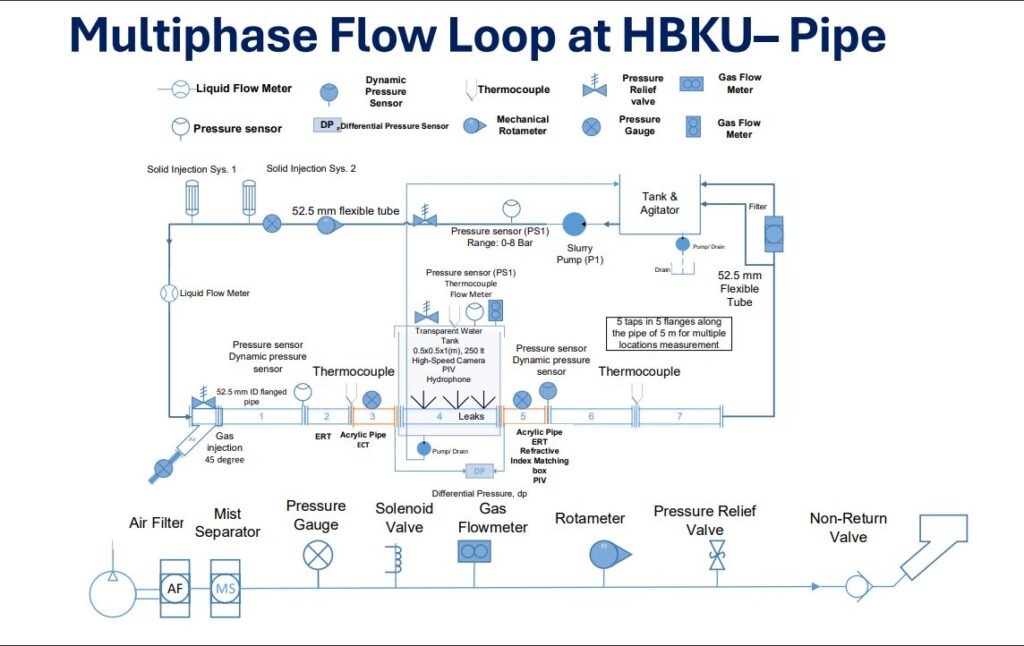
Electrical tomography’s ability to integrate with other technologies is obviously very useful in laboratory settings especially with regard to work examining multi-phase flows conducted through a flow-loop. Industrial Tomography Systems (ITS) recently worked with Hamad Bin Khalifa University (HBKU) on such a project to provide an electrical tomography system to improve phase detection and multi-flow characterisation for various multi-phase flow permutations including liquid-liquid-gas, liquid-liquid-solid, or liquid-liquid-gas-solid.
The schematic below is a representation of the Hamad Bin Khalifa University flow-loop and demonstrates the ease with which electrical tomography is able to integrate and compliment other monitoring technologies to represent a rounded comprehensive view of any variety of multi-phase flow.
While the Hamad Bin Khalifa University project was representative of a very common inline mixing application for ERT, an especially exciting development took place at the Toronto Metropolitan University where ERT was used to monitor a 3-phase mixing tank.
In results only published in January this year, the paper from Toronto used ERT in conjunction with calibrated pressure measurements to assess the behavior of gas and solid holdups within a non-Newtonian fluid under varying conditions. This study represented the first time that ERT and pressure measurement were combined in an experimental apparatus.
The findings of this study are highly significant and important for industry across the board. Three-phase agitated tanks are commonly used across a wide range of industries including “chemical processing, pharmaceuticals, wastewater treatment, and biotechnology, where precise control over gas, liquid, and solid phases is crucial from process efficiency.”
The Toronto study demonstrated the contrasting behaviour of solid and gas according to variations in the rheological properties of a non-Newtonian liquid created by agitation; the observation and monitoring of which was made possible through the integration of ERT with pressure detection.
The Toronto study merely scratches the surface regarding ERT’s enormous potential to now be able to monitor a 3-phase mixing tank, but to also integrate and function seamlessly with other technologies.
For more information about electrical tomography and its potential to enhance your manufacturing process, please contact the team at sales.support@itoms.com.