


Market
Pharmaceutical Manufacturing
Pharmaceutical manufacturing turns liquids into dosed, sterile and documented product, and the equipment that touches those liquids is part of the quality system. Hygienic pumps, diaphragm valves, mass flow meters, filtration and CIP and SIP systems handle solvents, active ingredients, buffers and water for injection, under cleanability, material and validation requirements that leave little room for improvisation.
All articles in this market
Pharmaceutical Manufacturing — page 4 of 13



Promoted videos
Pharmaceutical Manufacturing in action
Ask the Expert
Ask a pharmaceutical manufacturing expert — free
Engineers and product specialists who answer technical questions from readers. The answer comes back to you by e-mail; when we publish it, other readers benefit too.
 Francisco Hernandez
HRS Heat Exchangers
Francisco Hernandez
HRS Heat Exchangers
Francisco graduated as an industrial technical engineer at the Universidad Politécnica de Cartagena (Murcia, Spain) in 1993, and joined HRS in 1998.…
Ask a question Ryan Fitzgerald
Anderson-Negele
Ryan Fitzgerald
Anderson-Negele
Ryan Fitzgerald, Product Manager at Anderson-Negele, is an expert for the process management sensor portfolio which includes electromagnetic flow meters, Coriolis flow…
Ask a question Lee Sandry
Watson-Marlow Fluid Technology Solutions
Lee Sandry
Watson-Marlow Fluid Technology Solutions
Hello, my name is Lee Sandry and I am a Sector Training Manager at Watson-Marlow Fluid Technology Solutions. My role primarily involves…
Ask a question Erik van den Bosch
Teledyne Gas & Flame Detection
Erik van den Bosch
Teledyne Gas & Flame Detection
A question on your Gas & Flame Detection needs ? Erik will guide you through the different solutions to protect your personnel…
Ask a questionMarket & Technology Focus
Pharmaceutical Manufacturing, in depth in your inbox
Every Thursday edition takes one market or technology in depth. These are the editions on this market — read them online or get the next one by e-mail.
Subscribe to our E-newsletters
Questions and answers
Frequently asked about pharmaceutical manufacturing
Pharmaceutical technology
Pharmaceutical Technology can be defined as all technologies related to the development (including analysis, test, research and development, and quality control) of a pharmaceutical form using natural, semi-synthetic, and synthetic active and auxiliary substances and industrial production.
Pharmaceutical technology includes methods, techniques, and instrumentation in the manufacture, preparation, compounding, dispensing, packaging, and storing of drugs and other practices used in diagnostic and determinative procedures and the treatment of patients.
Pharmaceutical manufacturing process
Pharmaceutical manufacturing is the industrial-scale development of pharmaceutical drugs by pharmaceutical companies. The process of pharmaceutical manufacturing can be broken down into a series of unit operations.
The sterile and non-sterile pharmaceutical manufacturing process needs to be designed and operated to minimize microbial contamination. Good design practices require an assessment of hazards and a calculation of risks, together with risk mitigation strategies.
A purposefully designed monitoring regime can achieve a correct risk-assessed process. The scope of such assessments needs to begin with supplier assessments and control of incoming raw materials through to distribution of the manufactured pharmaceutical product.
Pharmaceutical fluid handling equipment
Pharmaceutical fluid handling equipment includes a wide variety of equipment, such as (metering) pumps, capsule equipment (filling, sorting), mixing equipment, thermal processing equipment (coolers, chillers, dryers, heat-exchangers), (x-ray) inspection systems, and tanks for holding liquids.
To guarantee precise manufacturing and formulation development, nearly every process can be automated. Resultantly, there is a piece of pharmaceutical manufacturing equipment involved in every processing step.
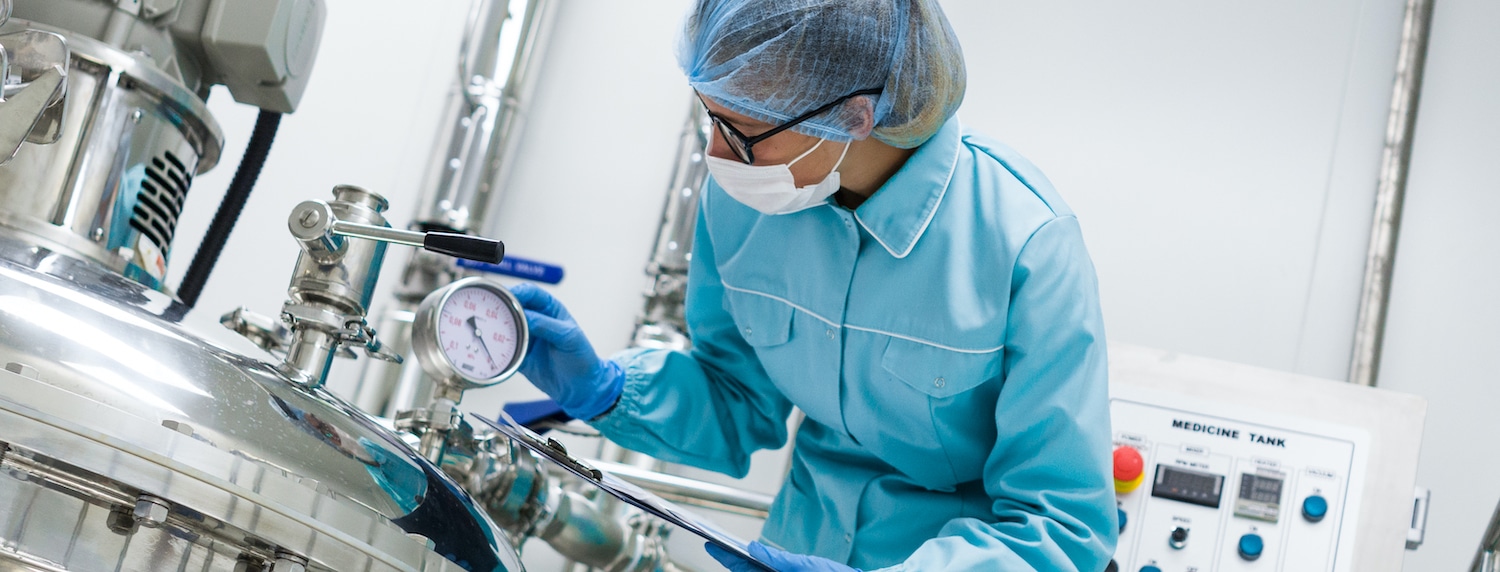
Hygienic fluid handling systems
Product integrity is crucial in the pharmaceutical industry. The highest sanitation standards must be observed for a product to maintain the same characteristics in every production batch.
In pharmaceutical processing industries, measuring and controlling the flow of liquids and gases demands exceptional process instrument performance and networkability.
Process systems for the preparation of pharmaceutical liquids
Production of pharmaceutical liquids is carried out in temperature-controlled stainless-steel tanks with stirring units under the addition of chemicals with or without nutrient solutions.
A complete understanding of the pharmaceutical production process is critical for the correct design. Clear definition, assessment, monitoring of essential parameters directly affecting product quality are the baseline for applying suitable process systems granting complete in-line and at-line quality control.
The vast majority of liquid pharmaceutical solutions require a variety of tankage, piping, and ancillary equipment for fluid mixing, filtration, transfer, and related activities. Suspensions, ointments, and other similar products, including the preparation of the solutions for freeze-dried products, can be manufactured in the same or very similar equipment.
Liquid dose manufacturing
Commercial liquid dosage manufacturing reaches large-scale production after being preformulated at the laboratory level, followed by formulation at the small scale and then at the pilot plant scale.
Due to the complexity of the liquid dose manufacturing process, scale-up from pilot to commercial production is not a simple extrapolation.
The primary ingredient in most liquid dose manufacturing processes is water. While it is the safest and most palatable solvent option, water quality is significant for the stability of pharmaceutical dosage forms.
Liquid pharmaceutical dosage forms
Liquid pharmaceutical dosage forms are essentially pharmaceutical products that involve a mixture of active drug components and nondrug components (excipients).
Liquid pharmaceutical dosage forms are prepared:
- By dissolving the active drug substance in an aqueous or non-aqueous (e.g., glycerin, ether, alcohol) solvent,
- By suspending the drug in an appropriate medium, or
- By incorporating the drug substance into an oil or water phase.
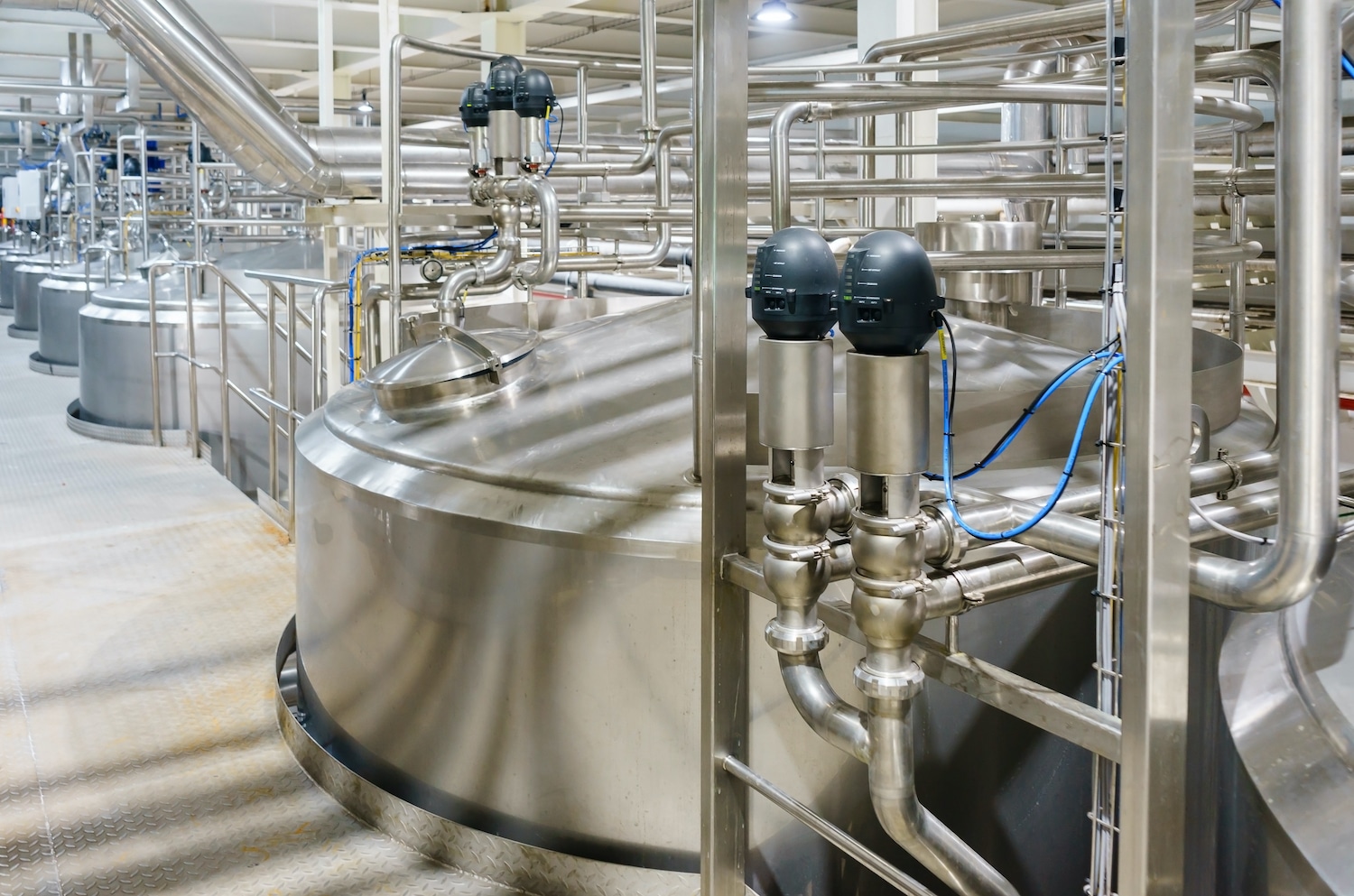
Sterile liquids manufacturing
Sterile liquids manufacturing is universally acknowledged as the most difficult pharmaceutical production process.
When these products are manufactured using aseptic processing, poorly controlled processes can expose the patient to an unacceptable level of contamination.
The production of sterile liquid products requires fastidious design, operation, and maintenance of facilities and equipment.
It also requires attention to detail in process development and validation to ensure success.
Sterile liquids manufacturing is heavily impacted by formulation and the selection of primary packaging components.
Fluid handling trends in pharmaceutical processing
The pharmaceutical processing industry is under constant pressure to increase efficiency, reduce costs, and maintain quality.
Forward-thinking pharmaceutical processing companies have invested in more innovative manufacturing and consider moving to a continuous manufacturing process.
The goals are clear, build in regulatory compliance, ensure close monitoring of processes, de-risk the manufacturing chain and enable fast drug release.
In pharmaceutical technology, the market has been increasing standardization in high added value equipment for years. Examples of this trend are autoclaves, freeze dryers, filling lines, distillers, etc.
However, when it comes to processing equipment for preparing, storing, and transferring liquid pharmaceuticals, no studies of needs and applications exist to date at the level of both engineering and pharmaceutical technology.
Which pumps are used in pharmaceutical manufacturing?
Sanitary centrifugal pumps circulate water for injection and cleaning fluids, while peristaltic, diaphragm and lobe pumps dose active ingredients, excipients and sterile product. Every wetted part has to be documented, cleanable and traceable to a material certificate. More in Pumps and Pumping Systems.
Which valves are used in pharma plants?
Sanitary diaphragm valves are the default because they are drainable and steam sterilisable with no crevices, supported by zero dead leg point of use valves on water loops and aseptic sampling valves. Surface finish and elastomer choice are part of the validation file. More in Process and Control Valves.
How is flow measured in pharmaceutical production?
Coriolis mass flow meters dose solvents and actives by weight rather than by volume, which removes the density question entirely. Magnetic meters follow purified water and WFI loops, where the minimum velocity that keeps the loop sanitary is itself a controlled parameter. More in Flow Control and Measurement.
How is filtration used in pharmaceutical manufacturing?
Sterile filtration of product and process gases, prefiltration ahead of it and integrity testing after it are part of batch release. On the utility side, filtration and UV protect the purified water system from bioburden. More in Fluid Filtration Systems.
Where is mixing used in pharmaceutical production?
Magnetic and top mounted mixers homogenise solutions, suspensions and emulsions in vessels that have to stay sterile. Bearingless magnetic drives avoid particle generation, which is why they are common in aseptic filling preparation. More in Fluid Mixing.
Which inline measurements are used in pharma?
Conductivity and total organic carbon monitor purified water and WFI continuously, while pH, UV and near infrared follow the product itself. These measurements are the backbone of process analytical technology and of continuous manufacturing. More in Process Gas and Liquid Analytical Systems.
How do I find an equipment manufacturer for pharmaceutical manufacturing?
Use the Manufacturers Directory A–Z or the Equipment Guide. Partner profiles carry direct contact details; other listings link to the company website.
Can I ask a technical question before I buy?
Yes. Ask the Expert puts your question to a field expert active in Pharmaceutical Manufacturing. The answer comes back to you by e-mail; when we publish it, other readers benefit too.