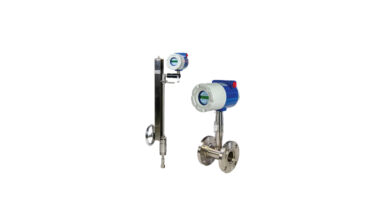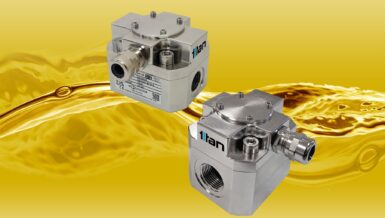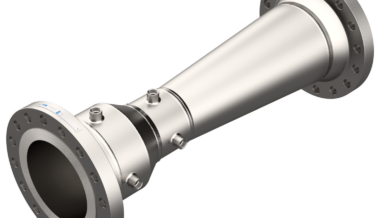






Pressure drop is the loss of pressure between two points in a pipe, caused by friction, bends or narrowing, obstructions, inserted instruments or leaks. Once lost, the pressure cannot be recovered. Fox Thermal explains why flow meter choice matters: thermal mass flow meters have no moving parts and cause negligible pressure drop.
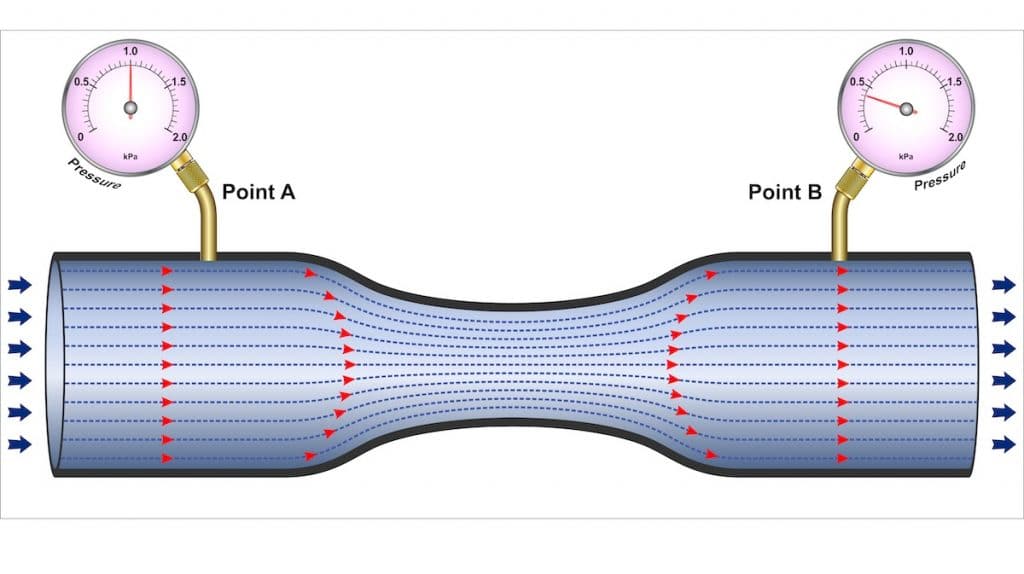
In Figure 1, we see a robust and high pressure reading at point “A” after which the pipe narrows. Then at point “B” we see a drop in the pressure reading. This is what is meant by pressure drop.
Maintaining pressure may have critical importance to the operation of the system, its equipment components, or the output of the process.
Typical causes of pressure drop:
- Friction from the walls of the pipe against the gas particles
- Bends in or narrowing of the pipe
- Obstructions inside of the pipe
- Sensors, probes, or other instruments inserted into the flow stream
- Leaks in the walls of the pipe
- Leaks from equipment installed on the pipe or in the process
Gas Flow Technologies and Pressure Drop Rates
There are many flow measurement technologies on the market today. Each technology uses different methods to arrive at a calculated flow rate in a pipe, but some technologies are known for causing pressure drops that may be undesirable. Once the pressure drops, it is unrecoverable. Let’s look at some common flow measurement technologies and their pressure drop ratings.

Negligible Pressure Drop in Thermal Mass Flow Meters
Thermal mass flow meters offer a direct mass flow measurement of air and gases in standard volumetric or mass units. A great benefit of the thermal mass flow technology is that there is a negligible or very low pressure drop in the pipe. There are no moving parts to interrupt flow and there is no need for additional pressure or temperature compensation to calculate the mass flow rate of the gas.
Other Benefits of Thermal Mass Flow Measurement
There are many benefits of thermal gas mass flow meters over other flow measurement technologies:
- Direct mass flow measurement of air and gases in standard volumetric units (e.g., SCFM or NM3/H) or mass units (e.g., LBS/M or KG/H)
- No additional pressure or temperature compensation required
- Repeatability and exceptionally broad measurement range: up to 1000:1 (100:1 typical)
- Standard linear 4-20mA output proportional to mass flow rate
- No moving parts
- Cost-effective
- Insertion, Inline, and remote* styles
- Measures flow rate and temperature
The Fox Thermal Digital Difference
Fox Thermal is revolutionizing thermal mass flow measurement technology with a series of innovations:
- Microprocessor-based, field-rangeable electronics
- DDC-Sensor™ proprietary flow sensor design*
- Gas-SelectX® field selectable gases / gas mixes without affecting accuracy*
- CAL-V™ and Zero CAL-CHECK® Calibration Validation*
- Free FT View™ Software to configure meter, print calibration validation certificates, run simulations, and more!*
- Data Logger with 7-year history*
*features vary by model number
FAQ – compiled by the Fluid Handling Pro editors
What causes pressure drop in a pipe?
Friction against the pipe wall, bends or narrowing, obstructions, instruments inserted into the flow, and leaks in the pipe or in equipment.
Why do thermal mass flow meters cause little pressure drop?
They have no moving parts to interrupt the flow, and they measure mass flow directly, without extra pressure or temperature compensation.
Editor’s summary, FAQ and links by the Fluid Handling Pro editors. The article text is by Fox Thermal.