



Temperature – As liquid temperature changes so too can its viscosity and density.
Pressure – Increasing pressure can place mechanical stresses on the meter body, gears, bearings and seals.
Specification – Accurate specification must consider the complete operating parameters rather than simply selecting a meter based on nominal flow rate.
The Effect of Temperature on Flow Measurement
Temperature is a particularly important consideration. As liquid temperature changes so too can its viscosity and density. Temperature can also cause thermal expansion within the flow measuring device itself, potentially altering the clearances between internal components. In positive displacement meters, where measurement depends on accurately defining a known volume and tolerances are very tight, even small changes in internal geometry can influence the amount of liquid displaced per cycle.
How Titan’s Oval Gear Flowmeters Minimise These Effects

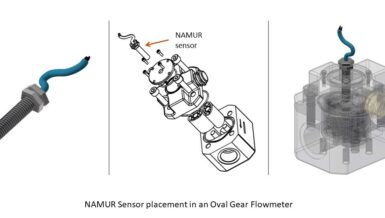
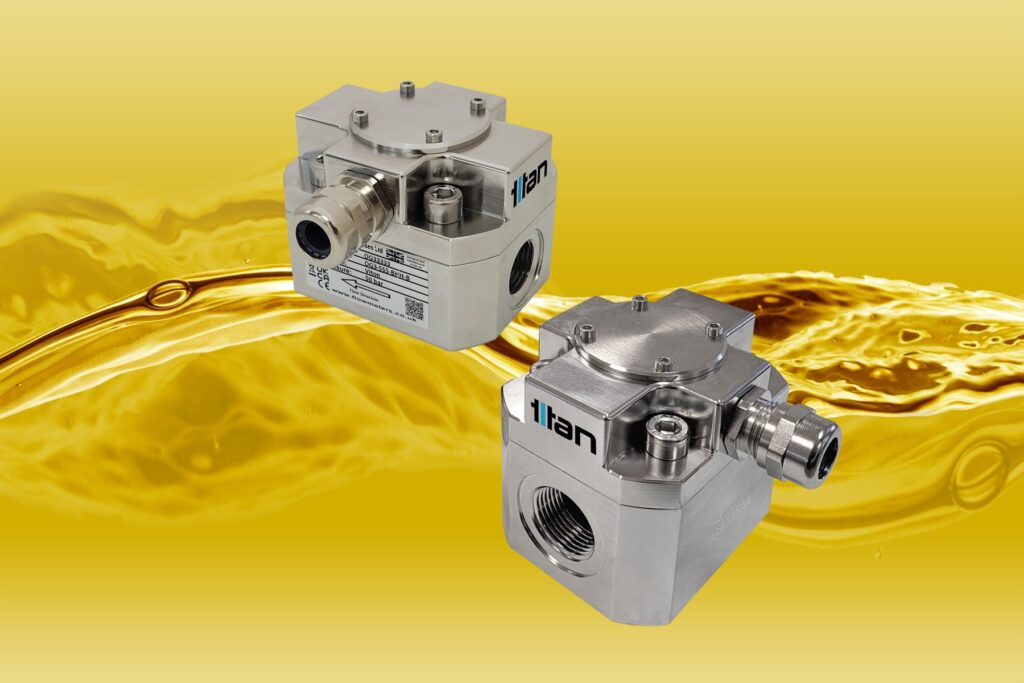
Titan Enterprises’ Oval Gear (OG) flowmeters are designed to minimise these effects. Two precision-machined oval gears rotate within a closely defined chamber, trapping and displacing discrete volumes of liquid as they turn. Magnets embedded in one of the gears are detected through the chamber wall by a Hall Effect sensor, reed switch or Namur sensor. The pulses generated correspond to the number of rotations of the gear and therefore to a known volume of liquid displacement.
Magnets embedded in one of the gears are detected through the chamber wall by:
- Hall Effect Sensor
- Reed Switch
- Namur Sensor
The Advantage of the Positive Displacement Principle
This positive displacement principle provides an important advantage: measurement is based primarily on the volume displaced rather than the velocity profile of the liquid. Consequently, OG meters are highly tolerant of changes in liquid properties and installation effects. Indeed, unlike many flowmeter technologies, their accuracy and range of measurement generally improve as viscosity increases, moving from around 1% to approximately 0.1% of reading with higher-viscosity liquids. As liquid viscosity increases, slip between the oval gears and the meter body is reduced, allowing the meter to capture a greater proportion of the actual flow and maintain higher measurement accuracy. Standard OG meters can measure liquids up to around 1000 cSt, with specially profiled gears available for viscosities above this range.
Pressure Introduces a Different Set of Challenges
Pressure introduces a different set of challenges. Increasing pressure can place mechanical stresses on the meter body, gears, bearings and seals, while pressure drop across the meter can become significant when measuring viscous fluids. Titan’s OG design uses the differential pressure generated across the meter to drive the gears. The larger effective surface area of the oval gears provides substantial driving force, delivering superior performance at low flow and maintaining a comparatively low pressure drop, helping extend the usable measurement range for viscous liquids.
Mechanical Integrity in High-Pressure Applications
For high-pressure applications, mechanical integrity becomes just as important as measurement performance. Titan has invested in dedicated high-pressure testing capability to validate meter designs, materials and performance under demanding conditions. Its high-pressure OG options can operate at pressures of up to 700 bar, with custom-designed versions tested to 950 bar, depending on model and specification.
Why Temperature and Pressure Cannot Be Considered in Isolation
Temperature and pressure therefore cannot be considered in isolation. A liquid’s viscosity may change substantially with temperature, while pressure requirements influence the mechanical design and pressure drop of the installation. Accurate specification must consider the complete operating parameters rather than simply selecting a meter based on nominal flow rate.
Matching the Meter to the Liquid and Operating Environment
For engineers, this is where the flexibility of Titan’s OG range becomes particularly valuable. With different gear profiles, materials, pressure ratings and configurations available, the meter can be matched to the liquid and operating environment. Combined with individual calibration and Titan’s controlled test facilities, this application-led approach helps maintain reliable, repeatable flow measurement where temperature, pressure and fluid properties would otherwise become limiting factors.
- Gear Profiles
- Materials
- Pressure Ratings
- Configurations
For more information, visit www.flowmeters.co.uk.