



Modern production meets 100 years of industrial history at the traditional MAN Truck & Bus site in Nuremberg. The development of ultra-modern, CO2-free drivetrains and the series production of high-voltage battery packs presented a stark contradiction to the generation of heat by combustion of pulverised lignite and natural gas. MAN contacted N-ERGIE, the local energy supplier in Nuremberg, to move away from these fossil fuels.
Andreas Wunram, Asset Manager Grid Development Pipes with N-ERGIE Netz GmbH, still recalls the initial discussions: “At the time, connecting MAN to our district heating network was a sensitive and hotly debated issue because the project was incompatible with the Technical Connection Conditions (TAB in German)” The problem is fundamental: Large industrial customers often cannot guarantee the low return flow temperatures required in the technical conditions of the district heating suppliers. However, these are necessary for efficient grid operation. “Even so, we were keen to connect MAN to our district heating network, because the climate protection and urban development potential is significant. Through this project, we gained redundancy in the network and were able to reliably supply a new neighbourhood with district heating. We needed a tailor-made solution that considered the interests and needs of suppliers and customers alike.”
District heating as a tailor-made solution
GEF Ingenieur AG were commissioned with the planning and Bilfinger Life Science GmbH with the construction work to realize this project. The list of requirements was extensive: At commissioning, the plant was expected to deliver an agreed output of 15 MW. A potential increase of up to 30 MW in supplied heat output was already planned. The exergy quantities (usable energy) in the high return flow temperatures of MAN were to be used to supply downstream customers by mixing them into the supply flow of the district heating network. This presented the challenges of covering a particularly large control range and dealing with seasonal fluctuations in the differential pressures in the primary network. MAN also prioritised the energy efficiency of the system.
Wunram relied on the Schubert & Salzer valves based on positive experiences to meet these requirements in two key aspects – flow rate control in the supply flow and pressure maintenance in the return flow line: “I experienced sliding gate valves for the first time in a biomethane gas conditioning project. Even with their large nominal size and wide control range, the valves were very compact and extremely light. That left a lasting impression back then. These sliding gate valves have been doing a really good job for many years now. We needed precisely this reliability and compactness for the system at MAN,” explains Wunram.
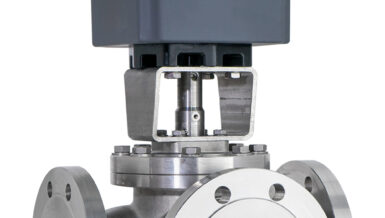
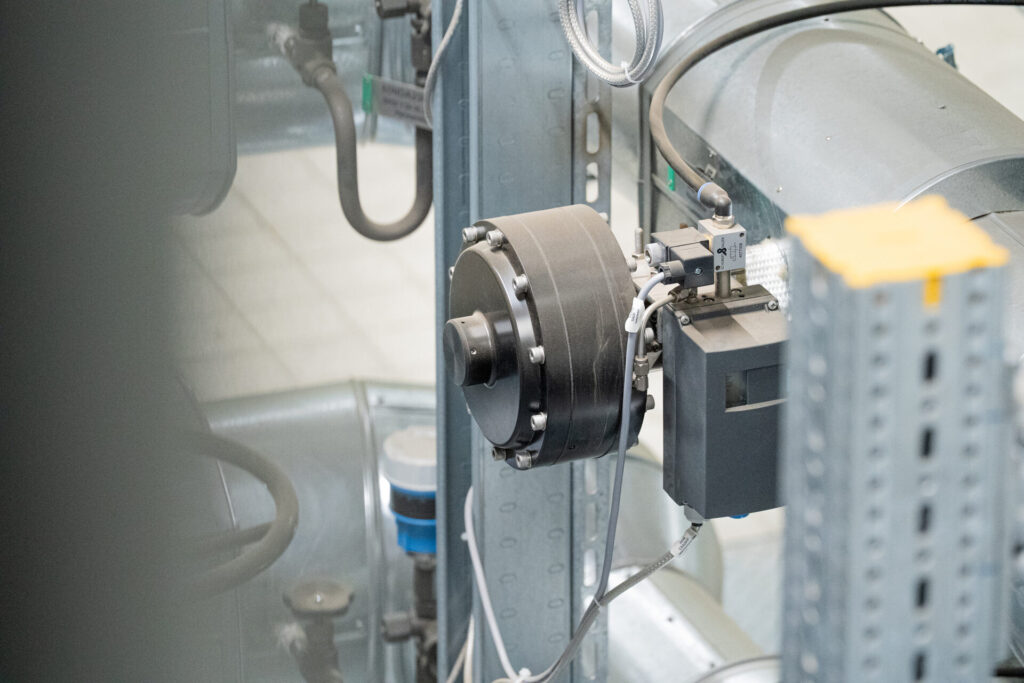
Six sliding gate valves in DN100, weighing just 24.9 kg each, are used to regulate the flow rate in the primary supply flow. These operate in cascade, divided into two groups of three valves, to regulate the volume flow rate of each heat exchanger skid based on the setpoint from the central process control system. The valves can be installed in the smallest spaces and without additional supports thanks to their low weight and compact size. They are very easy to insulate and thus minimize heat loss. It is easy, quick and cost-effective to carry out any necessary maintenance work.
There are two main reasons for the compact size and low weight of sliding gate valves. Firstly, the valves have an intermediate flange design, which is why the body is significantly smaller compared to other control valve types. Secondly, they use smaller actuators because sliding gate valves only require around 10% of the actuating force of a comparable globe valve. The underlying functional principle makes such performance possible: two slotted sealing discs that slide on top of each other to open up the flow cross-section. The actuator only has to cope with the low static and sliding friction between the sealing discs and a short valve stroke of 6 – 9 mm. This ensures short actuating times and permits fast control dynamics.
High-tech valves with low noise emission
The segmented disc valves used in the district heating system’s heat recovery plant provide similar benefits. The intermediate flange design and low actuating force make them extremely compact, weighing just 38.4 kg each. Unlike sliding gate valves, the sealing discs of segmented disc valves are not pushed against each other, but rotated on top of each other. This permits the realization of even higher KVS values and an even wider control range. In terms of sealing, they benefit not only from the high pressure differences, which press the sealing discs together, but also from an integrated set of springs that ensure reliable reverse sealing.
A key feature of the ‘tailor-made solution’ is the specific three-pipe connection, which allows to pump the return flow, in whole or in part, back into the primary network’s supply flow using a heat recovery plant. This minimizes the problems resulting from high return flow temperatures in the primary network and ensures better compatibility with the technical connection conditions (TAB) of N-ERGIE. Three segmented disc valves are used to maintain the suction pressure in cascade so that the feed-back pumps of the three-pipe connection can work optimally even with the strongly fluctuating differential pressures between the supply and return flow lines.
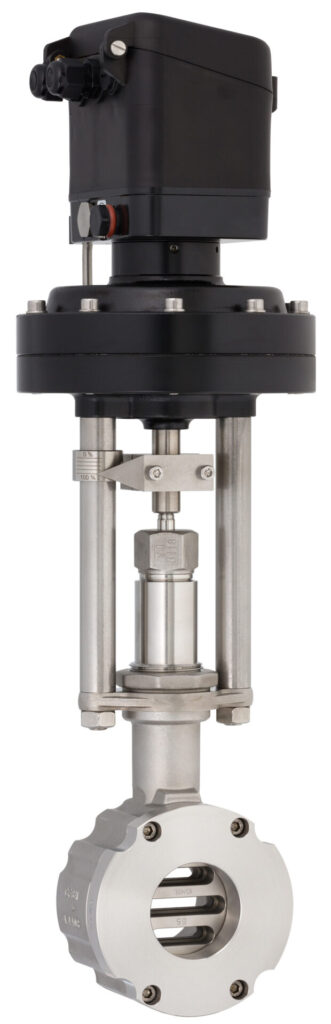
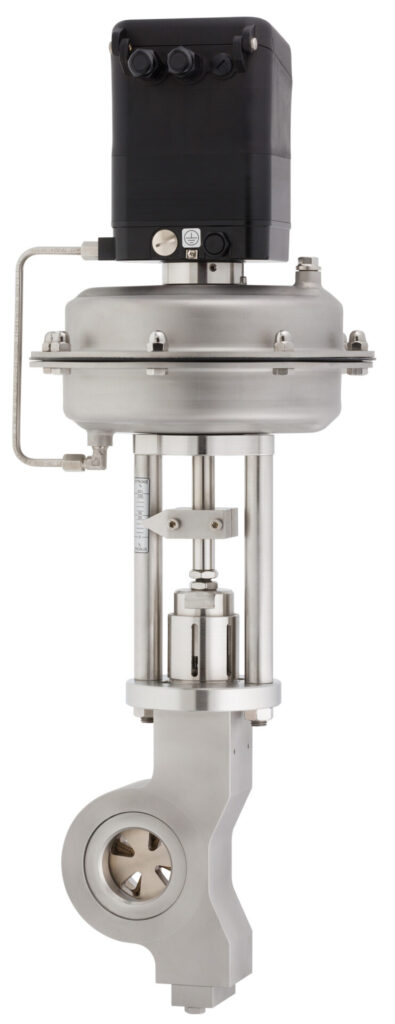
Because the plant is located directly next to the MAN control centre, particularly strict noise emission regulations apply here. Schubert & Salzer rapidly dispelled initial concerns about the noise level when controlling very small flow rates. The sealing discs of the segmented disc valves divide the flow into several smaller individual flows, which reduces the formation of strong and loud turbulence. The effect generally achieved by using perforated plates is an intrinsic principle of the system here. In comparison, the very thick housing walls of segmented disc valves additionally dampen the resulting noise. The result: Even during maintenance, when only two of the three valves are in operation for a short time, the noise limits are rarely exceeded.
A concept for the future
Thanks to the district heating connection, MAN Truck & Bus can avoid around 20,000 tonnes of CO2 emissions per year. The self-declared goal of reducing CO2 emissions at global production sites by 70% until 2030 (compared to 2019) is coming much closer. In the future, it will also be possible to feed waste heat from the MAN plant into the district heating network.
N-ERGIE can envisage connecting further industrial customers to the district heating network in future as so-called ‘prosumers’ and integrating any industrial waste heat flows into the district heating supply. Andreas Wunram explains: “At present, it is a matter of exploiting all available energy potential. For us, it is therefore also a pilot project that allowed us to demonstrate the feasibility and potential of such tailor-made solutions.”