



What is volumetric flow?
Volumetric flow, also referred to as actual flow, is a volume of medium moving per unit time. Common units for volumetric flow are m3/hr, m3/min, CFM or ACFM. The volume is a substance occupying a three-dimensional space. When the volume is a gas, it will expand or shrink with differences in temperature and/or pressure. When the temperature is raised, the space occupied by the volume will increase. When pressure increases, the volume will decrease. Therefore, when measuring volumetric flow, one must take into account the gas temperature and gas pressure.
What is mass flow?
Mass flow is the measure of a mass moving per unit time. This mass is represented by the number of molecules in a substance. The mass of a gas does not vary with changes in temperature and pressure, the weight remains the same. Mass flow rate can be expressed by e.g. kg/hr and lb/min. Gas measurement units are calculated in standard cubic meters per hour (m3n/hr) or standard cubic feet per minute (SCFM). Check this article to learn more about mass flow and calculations.
How to compare flow meter results
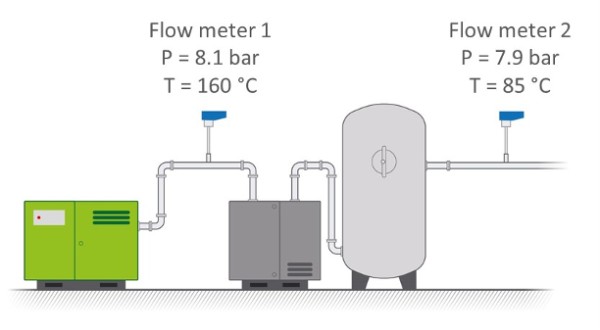
It is likely you have multiple flow meters installed in your plant. For example, one near the compressor and another one in the production hall. How do you compare the results between the two flow meters? After all, the pressure and temperature differ, as is shown in this graphic. Your action depends on which kind of flow meter you have.
- Volumetric flow meter: pressure and temperature must be taken into account in the calculations. This makes the comparison not easy.
- Mass flow meter (with the same reference conditions): you can directly compare the results and no additional calculation is necessary.
When to use a volumetric flow meter or a mass flow meter
Volumetric flow meters are recommended when measuring volumetric flow of the gas and when high accuracy is not needed. However, when comparing results, a volume flow meter requires additional temperature and pressure compensation. Whereas mass flow meters measure flow rate independent of gas pressure and temperature. Mass flow measurements are thereby more reliable and offer a higher accuracy and repeatability.
How to convert mass flow to volumetric flow
It is clear that mass flow meters have a lot of advantages. However, a lot of people in the industry are still used to flows in volume. This is because historically, most measuring instruments measure in volumetric flow. Fortunately, a mass flow meter can easily provide flows in volume. That is achieved by adding the volume (a.k.a the pipe diameter) to the flow meter.
The importance of reference conditions
Reference conditions define the mass of a gas, at a fixed temperature and pressure. This information is vital when comparing results. Not taking them into account can provide results that are up to 10% off. This is especially true for mass flow, because the mass of 1m3 gas is defined by pressure and temperature. Have you converted mass flow to volumetric flow? Even then reference conditions are still important. Read more here about common reasons for faulty air flow readings.
European reference conditions
A common European reference is at 0°C and 1,013 bar. This can be referred to as the normal reference condition. The normal reference condition is marked by an “n” as subscript in the unit, for instance mn/sec or m3n/hr.
Note that the European normal reference condition is not the only standard in the industry. A different European standard reference condition is provided at 20°C and 1,013 bar. This standard reference condition is shown by an “s” as subscript in the unit, like ls/min.
American reference conditions
The American standard reference condition is not equal to the European normal reference. It is marked with “S” as the first letter in the unit, like SCFM. Thus, reference conditions are 20°C and 1 bar.
Whereas ACFM (short for ‘actual cubic feet per minute’) is volumetric flow. Both ACFM and SCFM are used to specify compressors, so be aware of the difference.