



True hygienic performance, however, depends on more than component choice. It’s the result of decisions made at every stage, from system design and material selection to manufacturing, quality control, and maintenance in operation. At Parker, we view hygienic design as a system-wide discipline, with component specification being the final step in a much broader process.
Consistent performance across variable temperatures and pressures demands high-integrity materials, compliance with strict food safety standards, precision manufacturing to eliminate crevices where microbes can grow, and robust supply chains that ensure reliability over time.
When these principles come together, food and beverage producers can achieve exceptional hygiene standards while minimizing downtime, even in the most demanding environments.
Best practices for implementation and selection
A systems approach to hygiene begins with understanding the environment. By analyzing every stage of operation—from the fluid types conveyed to how cleaning phases are implemented between product runs—fundamental decisions about material and seal selection can be made with confidence, balancing chemical resistance, mechanical strength, and compliance requirements to make each component maximally effective in its specific role.
Factor 1: Matching components to application
Several factors determine whether seal geometry precision—the relationship between manufacturing precision, tubing diameter, seal dimension, and clamping force—can maintain equipment integrity under pressure and temperature changes. These qualities are assured with extensive endurance testing: selected fittings have handled up to 240 million pressure cycles without failure.
Factor 2: Balancing hygiene with business drivers
Not every zone requires the same level of hygienic design – the principle is the right product, in the right place: stainless-steel fittings for areas in direct food contact, specialized polymers in support systems, and standard industrial materials in non-contact parts of the layout. This approach achieves compliance while preserving cost efficiency.
Factor 3: Minimizing downtime with reliable operation
The distinction between an adequate component and an optimal one can determine whether a fluid system experiences years of reliable operation – or constant unplanned shutdowns for maintenance. Parker’s approach – combining application analysis, precision testing, and field feedback – ensures that each component achieves the correct standard of hygiene and durability in-place, working in harmony with the system as a whole.
Material selection and design solutions
In fluid systems, the most hygienic fittings and hoses are designed to avoid the “harborage points” that trap fluids in place and lead to subsequent contamination. It’s a combination of smoothly engineered surfaces, precise connections that join seamlessly, and material choices that are correct for the conditions.
Parker fittings are shaped to minimize retention of material and allow unimpeded access of cleaning fluids, maintaining fluid flow without retention areas. Smooth external profiles further support cleanability in splash zones, where ingredients or cleaning solutions can come into contact with nearby equipment. Examples include:
- Parker LF3800 stainless-steel push-in fittings have external contours that prevent residue accumulation during washdowns – supporting faster and more effective cleaning cycles.
- EPDM and FKM elastomer sealing elements meet and exceed FDA and NSF food-contact standards, designed to resist deformation and degradation even under constant thermal cycling and chemical exposure.
- A non-porous inner surface, as in Parker’s PURE Hose range, enables minimal leakage for faster Clean-in-Place (CIP) operations; leak detection tests have demonstrated leakage levels one million times lower than regulatory minimums.
- Components for food contact and splash zones are engineered in 316L stainless steel, with surfaces finished for minimal roughness – all reducing material retention risk.
These practices ensure fluid flows resist build-up of contaminants in normal operation and cleaning.
From material science to real-world durability
Designing for hygiene also means designing for endurance – since cleaning chemicals, high temperatures, and mechanical abrasion all impose stresses that can erode sealing performance or alter material properties over time. By validating materials against the specific conditions in customer layouts, the most suitable polymers and metals for each combination of cleaning agents and processes can be selected.
Extensive long-term testing is key. Millions of pressure cycles are conducted to confirm mechanical integrity, while bacterial growth studies benchmarking Parker fittings against competing designs show lower retention and higher cleanability, creating a measurable hygiene advantage.
Conformance, traceability, and testing in-situ
Every valve produced by Parker undergoes 100% functional testing with leak verification and dimensional inspection during manufacture; variability between components is minimized, making sure each new component is identical to the one it replaces.
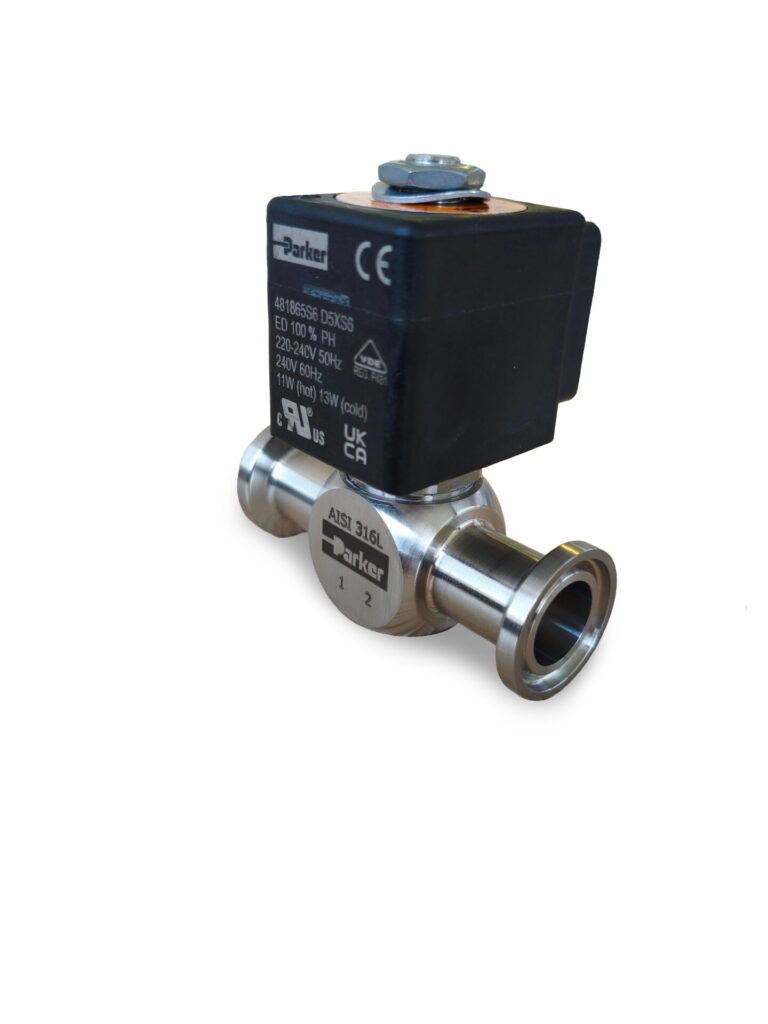
Traceability extends this assurance into distribution channels. Each valve is marked with its model and manufacturing date, while every shipment is linked to other data recording materials and supplier batches. This allows rapid identification and containment of affected components if an issue arises, preventing wider disruption.
Combined with scheduled supplier audits and part inspections on delivery, these traceability practices close the loop between design, production, and performance in the real world.
Future outlook and Parker
Food industry regulation is developing fast – with both diversity and commonalities across the world. Restrictions on lead content are tightening in multiple regions, with Germany (among others) planning complete bans and Asian markets introducing new material standards. Parker has already transitioned many products to stainless steel, advanced polymers, and high-performance aluminium – anticipating compliance needs before regulations mandate them.
A parallel trend is towards automation. Real-time monitoring, integrated pressure decay testing, and sensor-based validation are becoming key strategies for maintaining hygienic assurance. Parker’s portfolio already includes such systems. Compliant with HACCP, GFSI, and BRC frameworks, they’re capable of monitoring pressure and particle risks to verify process integrity on a continuous basis.
In addition, Parker manufactures its food and beverage components within Europe, with production sites in France, Germany, Italy, the UK, and Czechia. Local production shortens supply chains, enhances traceability, and supports a reduced carbon footprint – factors increasingly valued in a sector where sustainability and sourcing are often as important for compliance as hygiene. This regional manufacturing network ensures business continuity, providing customers with an established and reliable supply chain.
Hygienic performance by design
Long-term hygiene control depends on engineering discipline applied at every level: materials chosen for strength and integrity, geometries shaped for full cleanability, and traceable distribution that maintains assurance from production to point of use.
Parker’s approach unites all these principles with systems-level thinking, leading to complete fluid systems where hygiene, safety, compliance, and operational lifetimes remain high in the most demanding food and beverage environments. Demonstrating that hygiene is not an afterthought – it’s the outcome of deliberate design.