



The Challenge of Tolerance Compensation
Many port, feedthrough, and plug connections today are created by high-pressure die-casting, plastic injection molding, sheet metal forming, or similar manufacturing methods. The tolerances that can be achieved economically with these manufacturing methods are relatively large. For reliable sealing of housing openings and connections, that poses a considerable challenge. In many cases, conventional static sealing solutions are neither able to compensate for the aggregated tolerances in the tolerance chains nor can they be installed in a reliable process.
When the manufacturing tolerances exceed the range that standard seals reliably cover, additional costs are incurred due to rework, stricter manufacturing specifications, more complex installation processes, or even higher warranty risks. Consequently, efficient design no longer presupposes that the component perfectly fits the seal profile but that the seal actively compensates for the real assembly space.
Seal Development with a Technology-Focused Approach
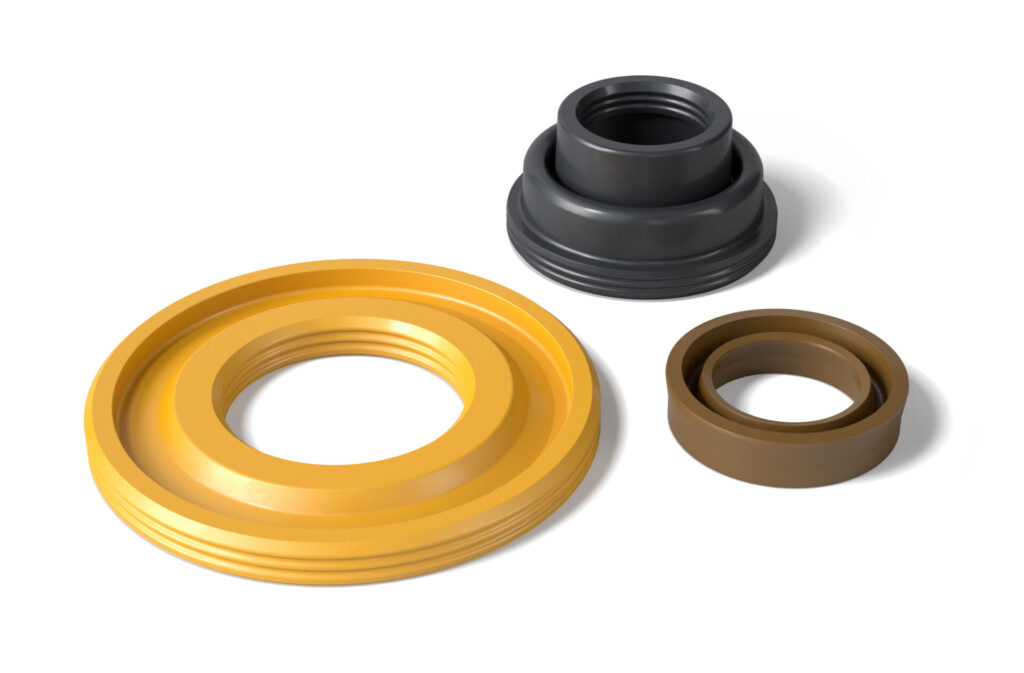
Parker Prädifa’s technology-focused approach to developing the Warp Seal product family compensates for axial, radial, and angular tolerances. Using suitably adapted materials, the Warp Seals deliver high resistance against a wide range of media and environmental influences. Other benefits include ease of assembly of various components without major design-related or functional restrictions. The product family is available in several variants for a variety of assembly spaces and tolerance compensation requirements.
The robust design of the seals and use of suitable materials guarantees reliable sealing of housing feedthroughs and plug connections even under challenging conditions. Depending on their design, Warp Seals can even function as pressure relief valves.
Versatile Uses
Warp Seals cover a wide range of applications, especially for large tolerance and high tightness requirements, including sealing of connections and feedthroughs in housings with axial, radial, or angular tolerances, as well as rods and pistons in hydraulic and pneumatic systems. Possible uses span the automotive industry, aerospace and defence, HVAC, industrial manufacturing equipment and mechanical engineering, off-road machinery, as well as hydrogen and fuel cell engineering, up to and including electrification and electric mobility where compact and flexible seals are required.
More information about Parker Prädifa’s Warp Seals can be found at: