








For many years, graphite has been the standard anode material in lithium‑ion cells. More recently, silicon has gained attention due to its significantly higher lithium storage capacity. However, this benefit is accompanied by a fundamental drawback: during charge and discharge cycles, silicon undergoes substantial volume changes, which can lead to mechanical degradation. To mitigate this effect, manufacturers are increasingly turning to silicon‑carbon composite anodes that combine enhanced capacity with improved structural stability.
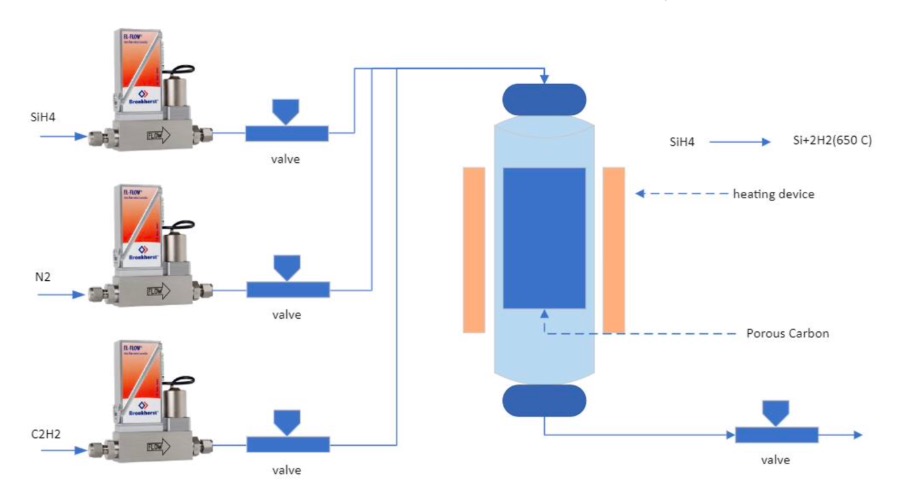
A common industrial route for producing such composites is chemical vapour deposition (CVD). In a typical process setup, a porous carbon substrate is exposed to a controlled mixture of reactive gases -often including silane, acetylene and nitrogen – inside a heated reactor. Under these conditions, the gaseous species react and form a thin silicon‑containing layer on the substrate surface. The uniformity and reproducibility of this deposition process depend heavily on the stability of the individual gas flows.
Among the precursor gases, silane presents particular challenges. As a highly reactive compound, it must be metered with extreme accuracy, often at very low concentrations relative to the full flow range. Even small deviations in silane dosage can alter the resulting microstructure of the anode material, potentially affecting cell lifetime, energy density or overall manufacturing yield. Consistent long‑term repeatability is therefore just as important as short‑term accuracy.
Thermal mass flow control is well suited to these requirements. In industrial battery production environments, thermal mass flow controllers, such as the EL-FLOW Select series of Bronkhorst, are applied to maintain stable and reproducible dosing of reactive gases in CVD processes. Because thermal mass flow measurement is based on the actual mass of the gas, it is largely independent of pressure and temperature fluctuations that are common in high‑temperature reactor systems. This enables consistent precursor supply throughout the full process cycle. High leak integrity and robust instrument design further support the safe handling of sensitive gases while minimising the risk of contamination or clogging.
Beyond precision and safety, scalability is a decisive factor for battery manufacturers. Processes developed at pilot scale must be transferable to large‑volume production without compromising consistency. Reliable, repeatable gas flow control plays a key role in this transition, helping manufacturers maintain process stability as throughput increases.
As battery technologies continue to mature, manufacturing requirements will become even more demanding. Although flow control systems are rarely in the spotlight, their contribution is fundamental: enabling controlled scale‑up and supporting the industrialisation of advanced anode materials that bridge the gap between laboratory innovation and commercial energy storage solutions.