




Key takeaways
- Globe valves remain the reference for precise throttling and high pressure drops; rotary valves are lighter and cheaper in large sizes.
- The flow characteristic — linear, equal percentage or quick opening — matters as much as the valve type.
- Sizing uses the flow coefficient (Cv or Kv) and standard equations such as IEC 60534.
- Shut-off tightness is specified as a seat leakage class (ANSI/FCI 70-2).
- Cavitation and flashing are the most common causes of noise, vibration and trim damage.
What is a control valve?
A control valve receives a signal from a controller and positions its closure member to keep a process variable at its set point. A complete control valve assembly usually consists of the body (the pressure-retaining part), the trim (plug, seat, cage, disk or ball — the parts that touch the flow and set the characteristic), the actuator (pneumatic, electric or hydraulic) and a positioner that makes sure the valve reaches the requested position [1].
Unlike an isolation valve, which is either open or closed, a control valve spends most of its life partly open. That makes it the busiest component in many Process and Control Valves applications — and the one most exposed to wear, noise and erosion. For a supplier’s view on the basics, see Understanding Control Valves for Fluid Regulation.
Types of control valves compared
| Type | Motion | How it controls | Typical strengths | Watch out for |
|---|---|---|---|---|
| Globe (single-port, cage-guided) | Sliding stem | Plug moves toward or away from a seat; a cage can shape the characteristic | Precise control, wide choice of trims, high pressure drops | Heavier and more expensive in large sizes |
| Angle | Sliding stem | Globe-type trim with inlet and outlet at 90° | Erosive, flashing or high-pressure-drop service; easy drainage | Body geometry limits installation options |
| Three-way | Sliding stem | Two inlets and one outlet (mixing) or one inlet and two outlets (diverting) | Temperature control by mixing or bypass | More complex trim; check pressure balance |
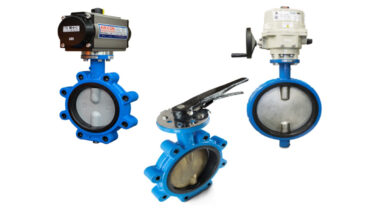
| Butterfly (conventional) | Rotary | Disk rotates in the flow path; conventional disks are typically limited to about 60° in throttling service [1] | Compact, low weight and cost in large sizes | Limited control range; high torque near closed |
| High-performance butterfly (eccentric disk) | Rotary | Off-center shaft lets the disk swing clear of the seal [1] | Less seal wear, tighter shut-off than conventional butterflies | Not ideal for very high pressure drops |
| Segmented (V-notch) ball | Rotary | Partial ball with a V-shaped edge | Wide rangeability, equal-percentage characteristic [1]; handles fibrous media and slurries | Higher cost than butterflies of the same size |
| Full-port ball | Rotary | Full sphere with a bore equal to the pipe | Low pressure loss, tight shut-off | Mainly on-off; coarse control near closed |
| Eccentric plug | Rotary | Plug cams into and out of the seat [1] | Erosive services; reduced friction and wear | Limited size range |
| Diaphragm / pinch | Linear | Elastomer diaphragm or sleeve closes the passage | Corrosive media, slurries, hygienic service | Pressure and temperature limits of the elastomer |
Sliding-stem valves are the choice when control accuracy, high pressure drops or severe service (noise, cavitation) dominate. Recent designs such as globe valves with fully body-guided discs target exactly those conditions.
Rotary valves win on size, weight and cost in large lines and in water, wastewater and bulk liquid service. Their actuators differ too: quarter-turn valves often use rack-and-pinion or scotch yoke actuators.
Flow characteristics: linear, equal percentage and quick opening
The inherent flow characteristic describes how flow changes with valve travel at a constant pressure drop:
- Linear: flow changes by the same amount for each percent of travel. Often used where the valve takes most of the system pressure drop.
- Equal percentage: each percent of travel changes the flow by the same percentage of the current flow — small changes near closed, larger ones near open. The most common choice in process control, because system pressure drop usually falls as flow rises.
- Quick opening: most of the flow change happens in the first part of travel. Used for on-off and relief-type duties.
In a real installation the pressure drop is not constant, so the installed characteristic differs from the inherent one. Manufacturers often quote rangeability figures such as 50:1 for equal-percentage valves, but control expert Béla Lipták notes that such claims are often exaggerated and that, judged by how much the valve gain may change, equal-percentage valves seldom exceed 10:1 in practice [2].
How control valves are sized
Valve capacity is expressed as a flow coefficient: Cv (US gallons per minute of water at a 1 psi pressure drop) or Kv (cubic meters per hour of water at a 1 bar pressure drop); Cv is roughly 1.16 × Kv. International sizing equations for liquids and gases are given in IEC 60534-2-1 and the equivalent ISA-75.01 [3].
Good sizing practice:
- Size for the real operating range, not only the maximum flow. A valve that spends its life below 20% open controls poorly.
- Check the pressure drop at minimum, normal and maximum flow.
- Challenge the process data: oversizing “for safety” is the most common sizing error — see Optimising Control Valve Specification by Challenging the Input Data.
Seat leakage classes
Shut-off performance is specified with the seat leakage classes of ANSI/FCI 70-2 [4]:
| Class | Maximum seat leakage (simplified) |
|---|---|
| II | 0.5% of rated capacity |
| III | 0.1% of rated capacity |
| IV | 0.01% of rated capacity |
| V | 0.0005 ml/min of water per inch of port diameter per psi differential |
| VI | Size-dependent limit in ml/min of air (soft-seated valves) |
A control valve is not an isolation valve. If tight shut-off is essential, specify the class explicitly — or add a separate isolation valve.
Common problems: cavitation, flashing and noise
When liquid accelerates through the valve trim, its pressure drops. If it falls below the vapor pressure, vapor bubbles form. If the pressure then recovers, the bubbles collapse violently — cavitation — causing noise, vibration and pitting. If the outlet pressure stays below the vapor pressure, the vapor remains — flashing — which erodes trim and body by high-velocity two-phase flow.
Countermeasures include staging the pressure drop with multi-stage or anti-cavitation trims, choosing angle bodies for flashing service, hardened trim materials and, where possible, moving the valve to a location with higher downstream pressure. See Good-bye Cavitation for one supplier’s approach; the physics is the same as in pumps, explained in What Is Cavitation in Centrifugal Pumps?
How to choose a control valve
- Define the duty: fluid, temperatures, pressures, flow range and allowable pressure drop.
- Check severe-service risks: cavitation, flashing, noise, solids, corrosion.
- Select the valve family: sliding-stem for precision and severe service; rotary for large lines, slurries and cost.
- Choose the characteristic to match the system (usually equal percentage).
- Size with Cv/Kv over the full operating range.
- Specify materials and standards, including seat leakage class and, for sour service, NACE requirements — see Difference Between NACE MR0175 and MR0103.
- Select actuator and positioner for the required speed, fail-safe position and diagnostics.
For a broader selection guide, see How to Select the Right Control Valve.
Control valves in practice
In Oil Processing, globe and angle valves handle high pressure drops and flashing hydrocarbons. In Water Processing, large butterfly valves dominate on cost and weight. Liquid Chemicals applications often call for lined or diaphragm valves — see Chemical Applications for Control Valves. In Power Generation, feedwater and steam conditioning valves face some of the most severe pressure drops in any plant.
FAQ
What is the most common type of control valve?
The globe valve, because it offers precise control and a wide choice of trims. In large lines, butterfly and ball valves are common for cost reasons.
What is the difference between a control valve and an isolation valve?
A control valve modulates flow continuously; an isolation valve is designed to be fully open or fully closed and to shut off tightly.
What does Cv mean?
Cv is the flow of water in US gallons per minute that passes through a valve at a pressure drop of 1 psi. The metric equivalent is Kv.
Which flow characteristic should I choose?
Equal percentage is the usual default in process control. Linear suits systems where the valve takes most of the pressure drop.
How can I prevent cavitation in a control valve?
Reduce the pressure drop per stage with anti-cavitation or multi-stage trim, select suitable trim materials and check the downstream pressure.
Sources
- Emerson, Control Valve Handbook, 6th edition (2023).
- Lipták, B., “How to select control valves, Part 2,” Control (2006).
- IEC 60534-2-1, Industrial-process control valves – Part 2-1: Flow capacity – Sizing equations for fluid flow under installed conditions; ANSI/ISA-75.01.01.
- ANSI/FCI 70-2, Control Valve Seat Leakage.
Related: The Art and Science of Control Valve Selection · Butterfly Valve Technology in Sugar Mill Operations · Pressure Control and Measurement