




Cavitation in a centrifugal pump is the formation and collapse of vapor bubbles in the liquid. It happens when the pressure at the impeller eye falls below the vapor pressure of the liquid, which means the net positive suction head available (NPSHa) is lower than the pump requires (NPSHr). The collapsing bubbles pit the impeller and casing.
What are the signs of cavitation?
If your pump sounds as though it is pumping marbles, you probably have a cavitation problem. Other signs are:
- excessive vibration, which leads to premature failure of seals and bearings
- higher power consumption
- lower flow and pressure
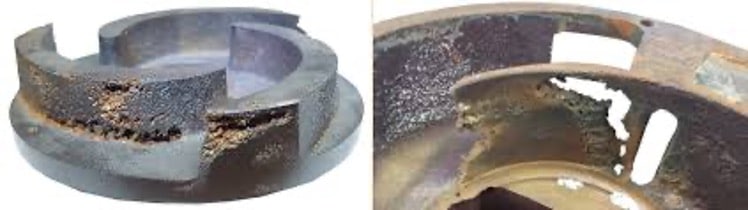
- pitting on the impeller; in severe cases the impeller looks like a sponge
Why does cavitation occur?
Water boils at 100 °C at atmospheric pressure, but at lower pressure it vaporizes at a much lower temperature. Inside a pump the liquid accelerates into the impeller eye, and as velocity rises, pressure falls (see Bernoulli’s equation and the Venturi effect). If the local pressure drops below the vapor pressure of the liquid, bubbles form. When they reach the higher-pressure zone further along the impeller vanes, they collapse in a series of small implosions that damage the metal.
What are NPSHa and NPSHr?
- NPSHa (available) is the margin between the absolute pressure at the pump suction and the vapor pressure of the liquid, expressed as head in meters. It depends on the installation.
- NPSHr (required) is what the pump needs to run without significant cavitation. It comes from the manufacturer’s pump curve and is usually defined as the NPSH at which the head drops by 3% (NPSH3).
For an open tank, NPSHa = (patm − pvapor) / (ρg) + hs − hf, where hs is the liquid level above the pump centerline (negative for a suction lift) and hf the friction loss in the suction line. Keep NPSHa above NPSHr with a margin; the Hydraulic Institute guideline ANSI/HI 9.6.1 recommends margins per application.
Worked example
Water at 20 °C is pumped from an open tank. The liquid level is 3 m below the pump centerline and the suction line loses 1 m of head. Vapor pressure of water at 20 °C is about 2.34 kPa and density about 998 kg/m³.
NPSHa = (101.3 − 2.3) kPa / (998 × 9.81) − 3 − 1 ≈ 10.1 − 4 = 6.1 m. With a pump that needs 4 m NPSHr at the duty point, the margin is 2.1 m. Warmer water, a longer suction line or a lower tank level all reduce that margin.
What types of cavitation are there?
Suction cavitation
Suction cavitation occurs when a pump runs under low pressure or high vacuum conditions. You find the damage around the eye of the impeller as multiple pitting. Possible causes:
- pump running too far to the right of its curve
- blocked suction pipe or strainer
- bad pipework design, including excessively long runs
- high inlet fluid velocity
- poor suction conditions
Discharge cavitation
Discharge cavitation can occur at very high discharge pressures or when the pump operates at less than 10% of its best efficiency point. This causes more recirculation within the pump and high fluid velocity at the outer edge of the impeller. The typical sign is pitting at the outer edges of the impeller. Causes:
- pump running too far to the left of its curve
- blocked discharge pipe or filters
- poor pipework design
How do you prevent pump cavitation?
First identify the cause of the pressure drop. Every measure below either raises NPSHa or brings the pump back to its design point:
- Simplify the suction pipework: remove as many bends and valves as possible.
- Move the pump closer to the fluid source, or raise the liquid level above the pump.
- Clean the pipework and remove blockages; maintain filters and strainers.
- Increase the diameter of the suction pipework to reduce the inlet velocity.
- Run the pump close to its best efficiency point instead of far to the left or right of its curve.
Cavitation is a common problem, but damage to impellers can largely be avoided with correct pump sizing, well-designed pipework and routine maintenance of filters and strainers. When you replace a damaged impeller, see how to dismantle a centrifugal pump.
Manufacturers of centrifugal pumps on Fluid Handling Pro
- DESMI: Danish manufacturer of centrifugal pumps for marine, offshore, industry and utility applications.
- Flowserve: US manufacturer of pumps, valves and mechanical seals for the process industries.
- Grundfos: Danish pump manufacturer for water, building services and industry.
- KSB: German manufacturer of pumps and valves, based in Frankenthal.
- Sulzer: Swiss manufacturer of pumps and related equipment for energy, water and process industries.
- Xylem: US water technology company whose pump brands include Flygt and Goulds.
FAQ – compiled by the Fluid Handling Pro editors
What is cavitation in a centrifugal pump?
The formation and collapse of vapor bubbles in the liquid because the pressure at the impeller eye falls below the vapor pressure. The implosions pit the impeller and casing.
What is the difference between NPSHa and NPSHr?
NPSHa is what the installation provides at the pump suction; NPSHr is what the pump needs, taken from its curve. Cavitation starts when NPSHa falls below NPSHr.
How do you stop cavitation quickly?
Check for a blocked strainer or suction pipe, make sure the suction valve is fully open, and check that the pump runs near its design point. If the problem stays, recalculate NPSHa for the installation.
Updated by the Fluid Handling Pro editors, November 2026.