



The system has been created to support laboratory prototyping and product development for a wide range of microfluidics applications, from laboratory test systems, to diagnostics and analytical instruments. The companies have made the design available online for customers to recreate and adapt to their needs.
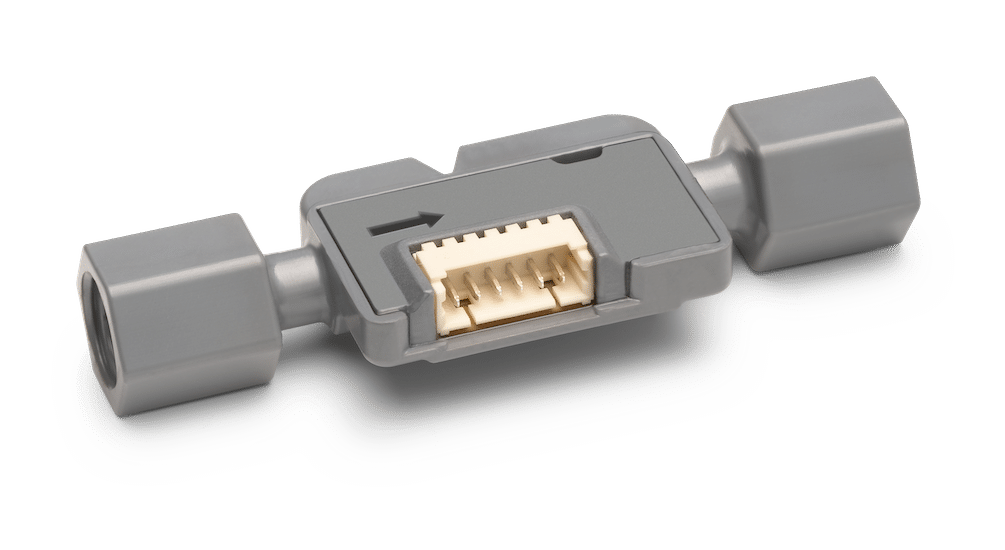
The system operates on a “pressure-driven flow” or “air over liquid” principle, in which gas pressure generated by the pump is used to drive liquid flow through the microfluidic circuit. If cross-contamination between liquids must be avoided, Sensirion’s LD20 single-use sensor can be used instead of the SLF3x sensor series. This separation of the pump from the liquid supports the reusable-consumable model widely adopted in diagnostics and analytical instruments, with the pump located in a reusable part of the system and the liquid path and sensor in a consumable.

The micropump’s pulsation-free pressure generation delivers smooth liquid flow with none of the oscillation often seen with conventional technologies, such as peristaltic pumps. This brings a number of benefits, including the ability to create laminar flow, reduction of measurement noise, and gentle handling of delicate materials. The pump also provides excellent pressure control which, together with the high-resolution capability of the sensor, results in unrivalled liquid flow control.
The companies have integrated Sensirion’s next-generation SLF3x series liquid flow sensor with TTP Ventus’ Disc Pump Evaluation Kit, taking advantage of the class-leading capabilities of each technology. The resulting stand-alone system provides a closed-loop, constant flow rate source for high-precision applications.
The system operates on a “pressure-driven flow” or “air over liquid” principle, in which gas pressure generated by the pump is used to drive liquid flow through the microfluidic circuit. If cross-contamination between liquids must be avoided, Sensirion’s LD20 single-use sensor can be used instead of the SLF3x sensor series. This separation of the pump from the liquid supports the reusable-consumable model widely adopted in diagnostics and analytical instruments, with the pump located in a reusable part of the system and the liquid path and sensor in a consumable.
The micropump’s pulsation-free pressure generation delivers smooth liquid flow with none of the oscillation often seen with conventional technologies, such as peristaltic pumps. This brings a number of benefits, including the ability to create laminar flow, reduction of measurement noise, and gentle handling of delicate materials. The pump also provides excellent pressure control which, together with the high-resolution capability of the sensor, results in unrivalled liquid flow control.
Both technologies offer a wide dynamic range, enabling flow control over several orders of magnitude, from microliters per minute, to several milliliters per minute, providing full flexibility when designing flow control protocols. The closed-loop flow regulation enables the system to respond to full-scale set point changes in just a few seconds, enabling protocols to be sped up, and minimizing wastage of precious or expensive materials.
Tom Harrison, Business Development Manager at TTP Ventus, explains: “With this collaboration, we wanted to show what is possible by combining TTP Ventus and Sensirion technology. We’ve demonstrated exceptional flow control with components small enough to be integrated into portable point-of-care devices.”
Susanne Pianezzi, Product Manager Liquid Flow Products at Sensirion, adds: “We hope the system we’ve created will provide a platform for product development and prototyping across the life science and industrial sectors, supporting the creation of a new generation of microfluidics devices.
”Visit Sensirion from October 19 to 23, 2020, at the Virtual Analytica 2020 and find out more about the collaboration and the liquid flow sensors of the SLF3x series: www.analytica-virtual.co,